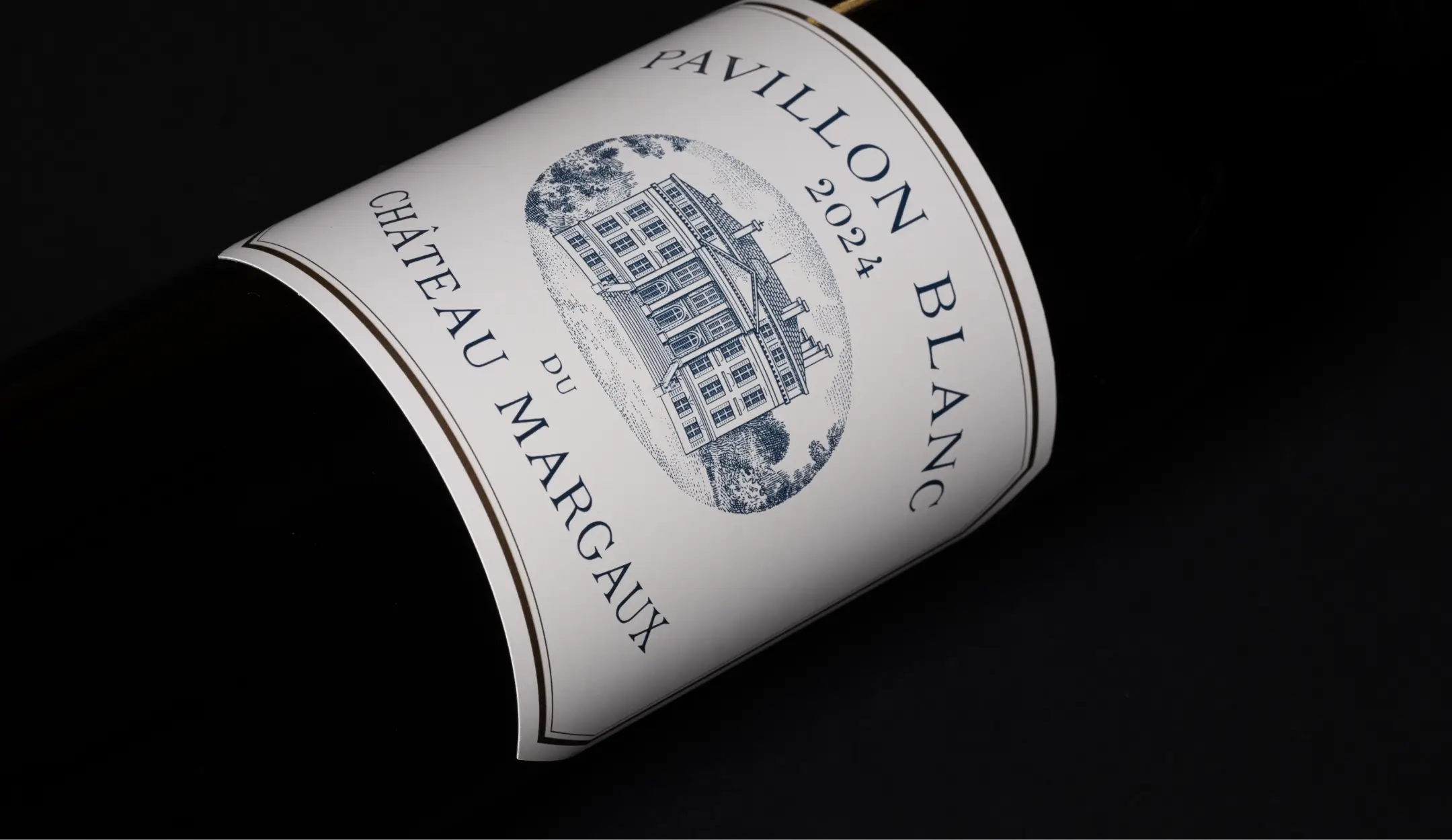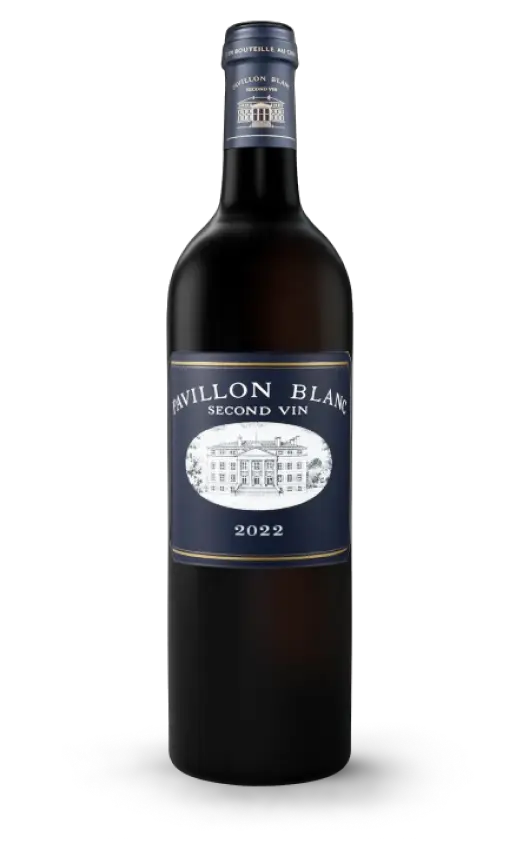

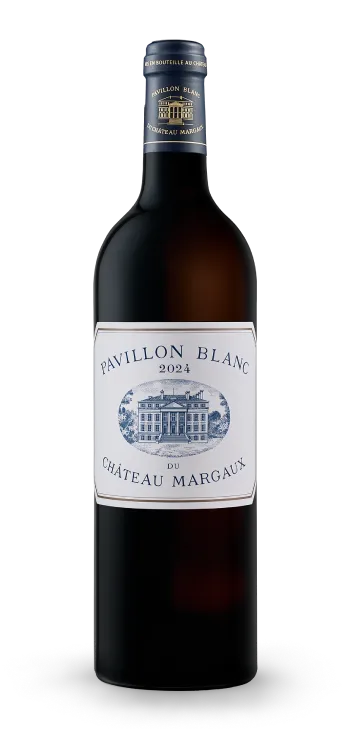
Pavillon Blanc du Château Margaux
Made exclusively from sauvignon blanc, Pavillon Blanc du Château Margaux expresses the purity and precision of this noble grape variety. Renowned for its finesse, aromatic richness and balance, it combines elegance, freshness and remarkable ageing potential.
History and winemaking
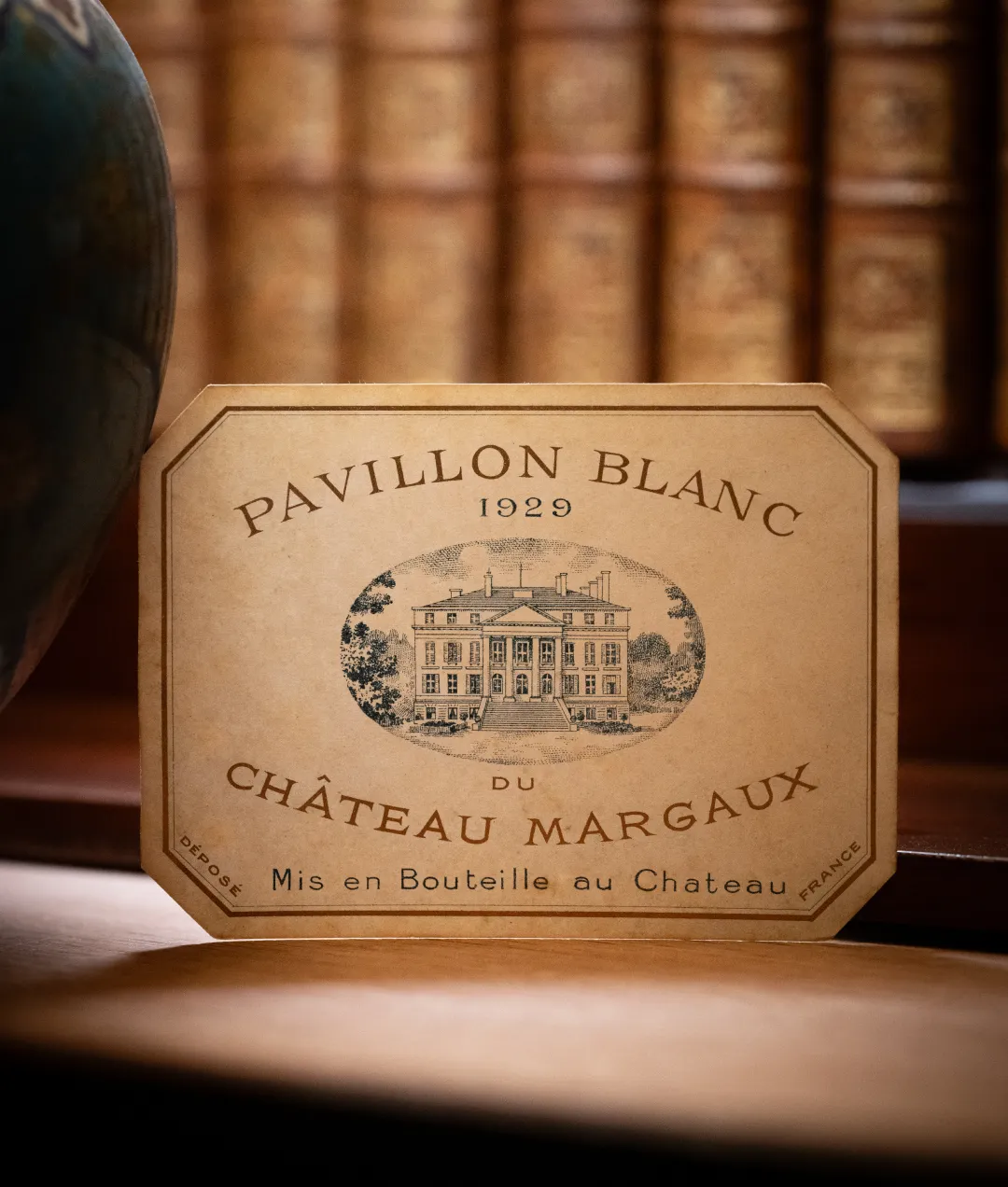
White wine production at Château Margaux dates back to the late 17th century. The cellar master of the time noted that he was among the first to separate white and red grapes during vinification. In the 19th century, this white wine was sold under the name “Château Margaux vin de sauvignon”. It has been known as Pavillon Blanc du Château Margaux since 1920, and its label has remained virtually unchanged ever since. The 12-hectare vineyard, planted exclusively with sauvignon blanc, lies on a historic plot of the estate. The vines, averaging around fifty years of age, yield particularly low crops, a guarantee of remarkable concentration and aromatic intensity. Since the 2009/2010 vintages, the production and selection methods have been completely rethought to achieve an even higher level of precision and excellence, as well as exceptional ageing capacity. Today, around 50% of the harvest is selected for Pavillon Blanc du Château Margaux, another portion is used for the Pavillon Blanc Second Vin, while the remainder is sold in bulk. The modern facilities of the new winery, designed by the architect Lord Norman Foster, allow for precise control over both vinification and ageing, ensuring the consistency and purity that have come to define Pavillon Blanc du Château Margaux.
History and winemaking
White wine production at Château Margaux dates back to the late 17th century. The cellar master of the time noted that he was among the first to separate white and red grapes during vinification. In the 19th century, this white wine was sold under the name “Château Margaux vin de sauvignon”. It has been known as Pavillon Blanc du Château Margaux since 1920, and its label has remained virtually unchanged ever since. The 12-hectare vineyard, planted exclusively with sauvignon blanc, lies on a historic plot of the estate. The vines, averaging around fifty years of age, yield particularly low crops, a guarantee of remarkable concentration and aromatic intensity. Since the 2009/2010 vintages, the production and selection methods have been completely rethought to achieve an even higher level of precision and excellence, as well as exceptional ageing capacity. Today, around 50% of the harvest is selected for Pavillon Blanc du Château Margaux, another portion is used for the Pavillon Blanc Second Vin, while the remainder is sold in bulk. The modern facilities of the new winery, designed by the architect Lord Norman Foster, allow for precise control over both vinification and ageing, ensuring the consistency and purity that have come to define Pavillon Blanc du Château Margaux.
History and winemaking
White wine production at Château Margaux dates back to the late 17th century. The cellar master of the time noted that he was among the first to separate white and red grapes during vinification. In the 19th century, this white wine was sold under the name “Château Margaux vin de sauvignon”. It has been known as Pavillon Blanc du Château Margaux since 1920, and its label has remained virtually unchanged ever since. The 12-hectare vineyard, planted exclusively with sauvignon blanc, lies on a historic plot of the estate. The vines, averaging around fifty years of age, yield particularly low crops, a guarantee of remarkable concentration and aromatic intensity. Since the 2009/2010 vintages, the production and selection methods have been completely rethought to achieve an even higher level of precision and excellence, as well as exceptional ageing capacity. Today, around 50% of the harvest is selected for Pavillon Blanc du Château Margaux, another portion is used for the Pavillon Blanc Second Vin, while the remainder is sold in bulk. The modern facilities of the new winery, designed by the architect Lord Norman Foster, allow for precise control over both vinification and ageing, ensuring the consistency and purity that have come to define Pavillon Blanc du Château Margaux.
Blending and ageing
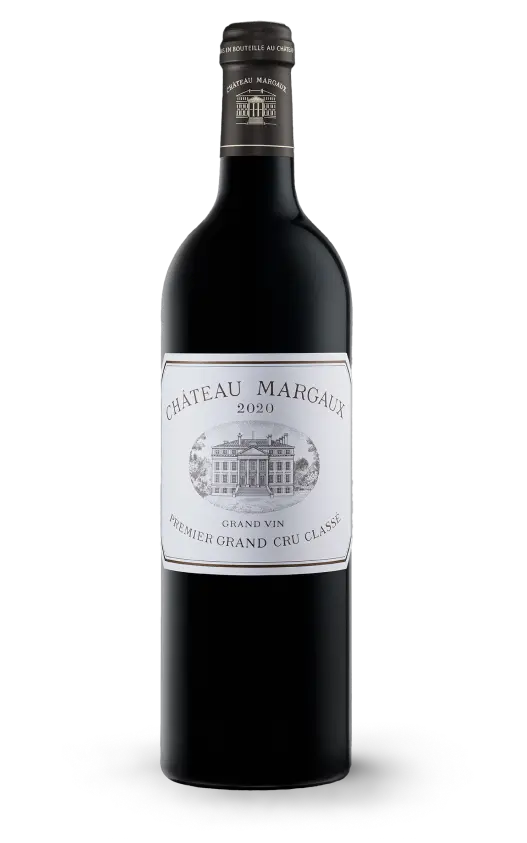
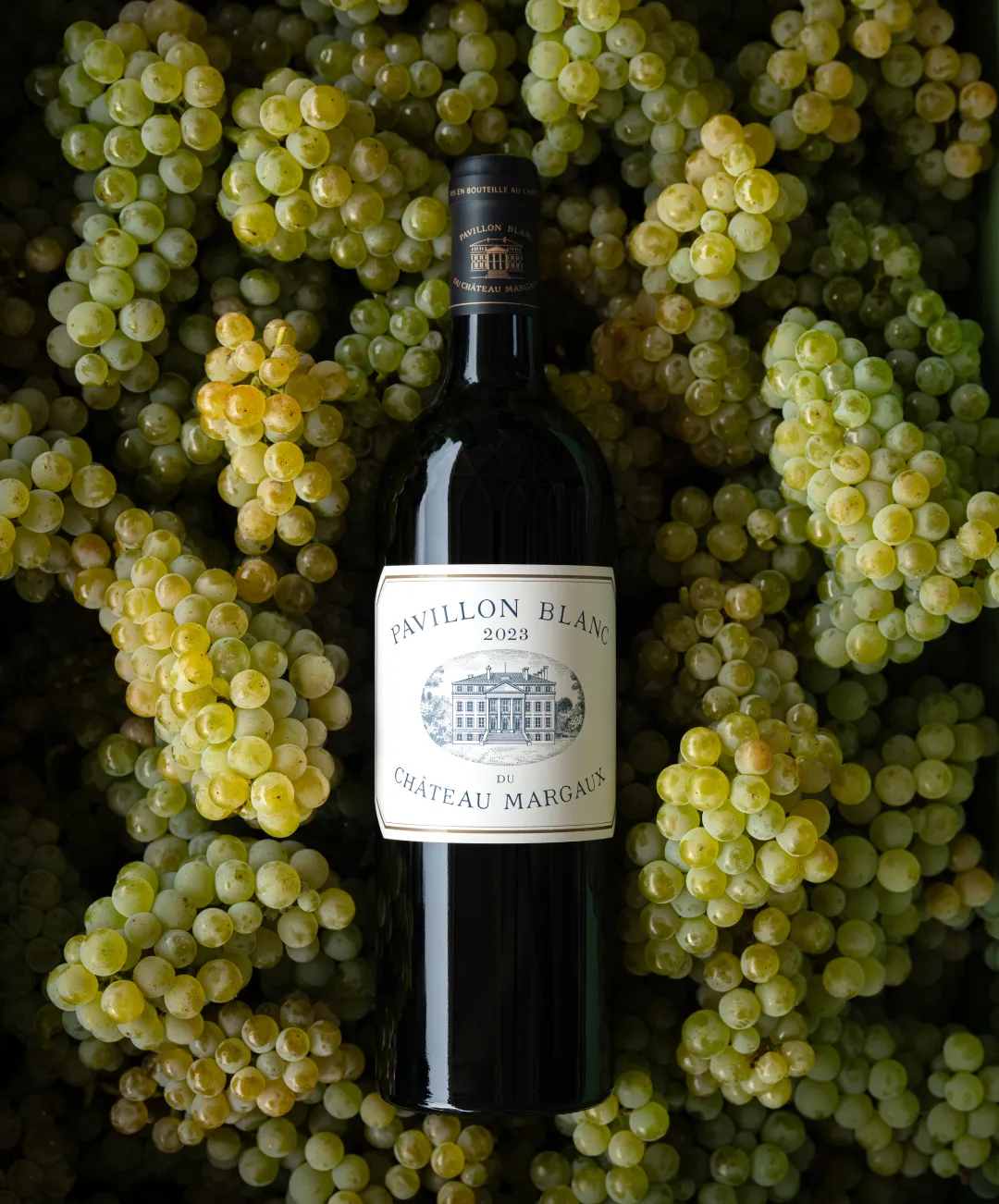
Pavillon Blanc du Château Margaux is aged for around eight months, with approximately 20% in new French oak barrels. Part of this ageing also takes place in 350-litre barrels. Production remains very limited, generally around 12,000 bottles per year. Since the 2017 vintage, the wine has been sealed with a Diam, a technical cork providing optimal protection. This closure also reduces the risk of cork taint and, combined with a dark bottle identical to that used for our red wines, shields the wine from light and ensures optimal ageing. Pavillon Blanc du Château Margaux combines the richness and density typical of great sauvignon blanc with a vibrant and lasting freshness. This balance, rare for a wine of such breadth, gives it a structure that is both full and taut, without heaviness, where supple texture harmonises beautifully with precise acidity. This equilibrium ensures the wine's remarkable longevity.
Blending and ageing
Pavillon Blanc du Château Margaux is aged for around eight months, with approximately 20% in new French oak barrels. Part of this ageing also takes place in 350-litre barrels. Production remains very limited, generally around 12,000 bottles per year. Since the 2017 vintage, the wine has been sealed with a Diam, a technical cork providing optimal protection. This closure also reduces the risk of cork taint and, combined with a dark bottle identical to that used for our red wines, shields the wine from light and ensures optimal ageing. Pavillon Blanc du Château Margaux combines the richness and density typical of great sauvignon blanc with a vibrant and lasting freshness. This balance, rare for a wine of such breadth, gives it a structure that is both full and taut, without heaviness, where supple texture harmonises beautifully with precise acidity. This equilibrium ensures the wine's remarkable longevity.
Blending and ageing
Pavillon Blanc du Château Margaux is aged for around eight months, with approximately 20% in new French oak barrels. Part of this ageing also takes place in 350-litre barrels. Production remains very limited, generally around 12,000 bottles per year. Since the 2017 vintage, the wine has been sealed with a Diam, a technical cork providing optimal protection. This closure also reduces the risk of cork taint and, combined with a dark bottle identical to that used for our red wines, shields the wine from light and ensures optimal ageing. Pavillon Blanc du Château Margaux combines the richness and density typical of great sauvignon blanc with a vibrant and lasting freshness. This balance, rare for a wine of such breadth, gives it a structure that is both full and taut, without heaviness, where supple texture harmonises beautifully with precise acidity. This equilibrium ensures the wine's remarkable longevity.
Through the vintages
Rediscover the Pavillon Blanc du Château Margaux through its vintages
Select your year
Pavillon Blanc du Château Margaux
2025
The harvest for Pavillon Blanc 2025 took place very early, between August 18th to 22nd, when the grapes were at optimal ripeness, thereby preserving their acidity, freshness and aromatic complexity. This vintage has a similar balance to 2022.
The nose is deep, offering notes of fresh hazelnut, white peach and lilac. On the palate, the wine is rich and full-bodied, while at the same time retaining a delightful freshness. The salinity brings liveliness and length, making for a harmonious, persistent expression.
However, volumes were among the lowest in the last fifty years, with yields of just 16 hl/ha. Only 45% of the harvest was selected for the Pavillon Blanc 2025 blend. Sadly, this was the smallest number of bottles we have ever produced.
Blend: 100% sauvignon blanc.
Climate
Le millésime 2025 est marqué par une saison contrastée, avec un printemps doux et équilibré, sans excès ni déficit, suivi d’un début d’été et d’une période estivale plutôt secs, rappelant le profil de 2022. Le débourrement intervient avec une semaine d’avance, précocité que l’on retrouve également dans la floraison. Celle-ci se déroule de manière rapide et homogène, dans des conditions climatiques particulièrement favorables, sans coulure ni millerandage.
La pluviométrie reste faible au début de l’été, installant progressivement un déficit hydrique. Le mois d’août est dominé par un épisode caniculaire, entraînant une accélération des maturités, notamment sur le sauvignon blanc.
En fin d’été, près de 60 mm de précipitations tombent entre fin août et début septembre. Ces pluies, attendues, apportent un rééquilibrage hydrique et une baisse des températures, permettant une maturation plus régulière et homogène en fin de saison. Malgré quelques épisodes pluvieux ponctuels en septembre, les conditions sanitaires demeurent très bonnes.
Dans ce contexte climatique, le choix a été fait de ne pas avancer les dates de vendanges afin d’atteindre une maturité optimale, en particulier phénolique. Cette décision, assumée mais engageante, a permis d’atteindre un niveau de qualité particulièrement élevé, avec des raisins récoltés à parfaite maturité, exprimant pleinement le potentiel du fruit et du millésime.
Pavillon Blanc du Château Margaux
2024
The Pavillon Blanc harvest took place between the 2nd and 8th of September, slightly later than in recent years. Harvest conditions were ideal, with no health issues in the vineyard, enabling us to harvest at a calm, steady pace. The mild summer temperatures and absence of heat spikes favoured gradual ripening, preserving the balance between freshness and concentration. As always, our teams started early in the morning to harvest the berries at the coolest possible temperatures for optimal preservation of their aromas and flavours. On our 11 hectares dedicated to sauvignon blanc, plot selection plays a key role in the wine’s production. All our white grape plots are harvested and vinified separately in the modern winery designed by Norman Foster. Conceived to combine precision and excellence, these winemaking facilities allow each batch to be treated with meticulous care, further refining our quest to achieve the purest possible expression of sauvignon blanc. In our pursuit of perfection, we have applied even more rigorous standards. In recent years, less than half of the harvest has been used for Pavillon Blanc du Château Margaux with the remainder going to the Pavillon Blanc Second Vin. This enables us to further refine the Pavillon Blanc style.
Climate
Weather factors impacting the 2024 vintage began in 2023 with exceptional amounts of rain. From autumn onwards, there was an unusually intense accumulation of rainfall for several months. Between the 18th of October and the 28th of March, more than 1,000 mm of rain fell in the vineyard, surpassing the previous record for rainiest vintage by 300 mm. With mild winter temperatures, 3°C higher than historical averages in March, the abundance of water and warmth provided ideal conditions for the vines to start their growth cycle well ahead of schedule. Bud break occurred between the 22nd and 25th of March, 7 to 10 days earlier than in recent years. However, the wet weather continued, setting the pace for the entire growing season. While some past great vintages, such as 2000, had similar rainfall, what set 2024 apart was the frequency of rainy days. Access to the plots became a constant challenge, and the omnipresent threat of downy mildew meant that teams had to remain vigilant at all times. In this challenging context, flowering was slightly delayed, spanning from the 31st of May to the 7th of June.
Véraison, when the grapes change colour, took place between the 9th and 23rd of August, and was reminiscent of vintages such as 2014 and 2016, confirming a growth cycle significantly influenced by wet weather. Faced with these conditions, the vines reacted in contrasting fashions. Plots with very cool, deep soil suffered from downy mildew, particularly affecting the volumes destined for our third wine, Margaux du Château Margaux. Conversely, our gravelly terroirs, with better drainage and earlier ripening, were able to preserve their potential and produce some of the finest grapes of the vintage.
While the weather conditions put the vines to the test, they did not compromise the exacting stan - dards and precision with which our teams work on every Château Margaux vintage. With an average yield of 30 hl/ha, the sorting carried out by our pickers in the vineyards was more rigorous than ever, highlighting the most resilient terroirs and offering an optimal balance between concentra - tion and finesse.
Pavillon Blanc du Château Margaux
2023
The Pavillon Blanc harvest took place between September 2nd and 8th, slightly later than in recent years. Harvest conditions were ideal, with no health issues in the vineyard, allowing us to work at a calm, steady pace. The mild summer temperatures and absence of heat spikes favoured gradual ripening, preserving the balance between freshness and concentration. As always, our teams began early in the morning to pick the berries at the coolest possible temperatures for optimal preservation of their aromas and flavours. On our 11 hectares dedicated to sauvignon blanc, plot selection plays a key role in the wine’s production. All our white grape plots are harvested and vinified separately in the modern winery designed by Norman Foster. Conceived to combine precision and excellence, these winemaking facilities allow each batch to be handled with meticulous care, further refining our quest to achieve the purest possible expression of sauvignon blanc. In our pursuit of perfection, we have applied even more rigorous standards. In recent years, less than half of the harvest has been used for Pavillon Blanc du Château Margaux, with the remainder going to the Pavillon Blanc Second Vin. This enables us to further refine the Pavillon Blanc style. (November 2025)
Climate
The winter of 2022-2023 was relatively mild, although there were about ten days of real winter temperatures in the first half of February.
There was also not much rain during the first few months of 2023: 196 mm in Margaux, allowing only a very light replenishment of groundwater reserves after an extremely hot, dry 2022 vintage. In these conditions, bud break occurred between the 3rd and the 10th of April.
Fortunately, spring did not bring any of the feared frosts. Rain was sparse but frequent during the growing season. There were just two weeks of sustained rain in June (72 mm). However, these conditions made it potentially difficult to keep the vines healthy. The high relative humidity in the air created very favourable conditions for downy mildew. Our vineyard teams succeeded in main¬taining healthy foliage to ensure good-quality ripening of the grapes and a successful harvest.
The vines flowered between the 31st of May and the 5th of June in good conditions, with no signs of coulure or millerandage.
2023 was markedly different from the previous vintage in terms of temperature. In 2022, there were very early heatwaves. In 2023, we had just one real heatwave, between the 17th and the 24th of August, the period when the grape skins mature, becoming thinner and more sensitive to the com-bined action of high temperatures and sunshine. The berries that were most exposed to the sun suffered scalding, forcing us to do a lot of sorting during the harvest.
Pavillon Blanc du Château Margaux
2022
The white harvest took place from August 23rd to the 30th. High temperatures in the last ten days of August meant that we had to pick the grapes earlier to retain all their potential acidity, which is so important in white wines. We even had to bring forward the picking times, starting in the early hours of the morning and finishing at midday.
We were determined to preserve the intensity and aromatic complexity that characterise our white wines, and to spare the pickers from working in the excessive heat.
We drew the best from our Virefougasse plots to craft a wine with complex flavours and aromas, and a well-rounded palate. Plot selection was even more rigorous in the vineyards. The grapes harvested from almost ten hectares were vinified in around twenty different batches. The trials undertaken over several years to create the second white wine, the Pavillon Blanc Second Vin, and its launch with the 2022 vintage have allowed Pavillon Blanc to become even more precise. (November 2025)
Climate
The description of the weather conditions has begun the same way almost every year for the last ten years: 2022 was once again the hottest year on record... and to this, we must add another climate phenomenon: a severe drought. However, these two factors impacted the harvest in such a way as to produce an extraordinary vintage.
Apart from some frosts in mid-January, the winter of 20x22 was mild and relatively dry, with just 150 mm of rain. Nationally, the spring of 2022 was the third warmest (13.2°C) since 1900, close behind 2011 and 2020. It was the same in Margaux, with record temperatures during June, sometimes exceeding 40°C. Fortunately, in typical Bordeaux fashion, there was regular rain throughout the spring, with 182 mm in Margaux. Summer brought further extremes: three long, intense heat waves; the thermometer again recorded temperatures over 40°C several times, and over 35°C for more than 14 days in July and August. Slightly more than six long weeks passed without a single drop of rain. The 20 mm that arrived at the end of August was welcome, but its effect was more to cool the air than to significantly rehydrate the surface soil.
In these conditions, budburst was relatively spread out, between March 28th and April 13th, depending on the grape variety and the nature of our diverse terroirs. Conditions were sufficiently good that no coulure or millerandage was observed in our plots during flowering, which took place in the week of May 24th, indicating an early vintage.
The summer weather then reinforced the early nature of the vintage. The white grape harvest took place extremely early, on August 18th.
For the red grapes, it lasted from September 8th to 27th, with normal temperatures in September and optimal harvesting conditions. The first autumn rains began on the last day of the harvest.
Pavillon Blanc du Château Margaux
2021
For this vintage, as with other recent hot, dry vintages, acidity was the key parameter that determined the beginning of the harvest. And it was this acidity that decreased very rapidly between early and mid-August. Thanks to the determination and professionalism of the team at the property, we were able to react quickly to start the harvest exceptionally early.
As with the red grapes, the Sauvignon Blanc berries were smaller, as were the bunches—perhaps a consequence of the spring frosts in 2021—and so yields were disappointing. However, the quality of the vintage and its relative uniformity allowed us to use 50% of the white grapes for the Pavillon Blanc blend. The aromatic precision is tremendous. Pavillon Blanc 2022 has a delicate, balanced mouthfeel.
It must be said that while every vintage brings new answers and teaches us something, it often also raises its fair share of questions. Sometimes we learn a little, and often we wonder a lot. Even if we do not completely understand it, this vintage is reassuring. Who could have imagined that such weather conditions could produce such well-balanced wines? (April 2025)
Climate
The winter of 2021 was relatively mild, although quite wet, with more than 230 mm of rain falling in the first two months of the year. With the month of March being drier and warmer, our vines flowered between the 23rd and the 30th of the month. Spring was marked by frequent and severe episodes of frost, testing the frost protection sprinkling systems on our white grape vineyards like never before. Temperatures fell so drastically that we lost close to a hectare's worth of our white harvest. On the other hand, our red grape vineyards were less affected by the cold, with only a few vines hit by some morning frost.
May and June recorded quite a bit of rainfall, and we had to be watchful to prevent the spread of fungal diseases. The determination of our team eventually paid off and we were able to maintain the grapes and leaves in good health. Budbreak occurred between the 1st and the 6th of March in average conditions, however the fruit-set was excellent, with only a few of the older plots falling prey to coulure or shatter.
After a rainy month of July, August and the first half of September were extremely dry. Just after we had finished picking the white grapes, we had about 45 mm of rain, raising concerns of a poor red harvest.
As in the 2017 vintage, we were faced with the following choice: pick grapes that were not fully ripe before they could potentially be attacked by Botrytis, or wait till the end of September to harvest the grapes when they would be riper and more concentrated from the additional sunshine. And as in that year, the decision was made to prioritise the quality of the grapes. The early Merlot plots were harvested on the 24th of September while the later Cabernet harvests only began by the 4th of October. The harvest was completed by the 13th of October. The season definitely presented its fair share of challenges, but the quality of our work and attention ensured we had an elegant and dense vintage.
Pavillon Blanc du Château Margaux
2020
The white grape harvest took place between September 7th and 13th, a little later than the average over the last ten years. As the acid potential of the vintage was high, acidity was not the only parameter in determining the harvest date: several other factors were equally important, such as the aromatic potential of the berries and their complexity upon tasting. The dates of the harvest were also planned to avoid the rains forecast for the second half of September. The grapes were in perfect health and above all, the juice concentration was excellent.
The Pavillon Blanc blend represents 52% of the 2021 harvest and is sumptuous on the palate. Perfectly balanced, with a rich and complex concentration, this wine opens with a creamy texture and has a fresh acidity that lends it an enduring, long finish. Its quality level is probably comparable to the 2017 vintage and will likely require some patience before reaching its peak. (November 2025)
Climate
As in the preceding vintages, 2020 saw average temperatures that were among the highest ever recorded due to a series of heatwaves and an exceptionally dry summer.
After abundant rainfall at the end of 2019, there was very little rain in the first quarter of 2020, 80 mm (3.15 inches) less than the thirty-year average. Winter 2020 stood out for its mild temperatures. Average temperatures were 3°C (37°F) above the thirty-year average and temperatures in February sometimes exceeded 20°C (68°F). Only four light frosts occurred in what was otherwise a mild winter. As a result, bud break was extremely early, from the 22nd to the 26th of March depending on the grape variety, approximately ten days earlier than average. The 2020 vintage promised to be an early one.
The spring was also very mild. Temperatures in April were among the hottest since 1962. Flowering occurred between the 21st and the 26th of May, in excellent conditions. There were no signs of coulure or millerandage. The spring was particularly wet, which meant a greater risk of disease that we nonetheless managed to control (very few signs on the leaves and none on the bunches).
The summer brought long and intense heatwaves between the 23rd of June and the 12th of August, as well as significant drought, with no rain at all between the 19th of June and the 10th of August. Ripening occurred between the 23rd and the 26th of July. It was only during the second ten-day period of August that rainfall helped limit potentially excessive hydric stress. Nearly 80 mm (3.15 inches) of rain fell on August 13th. In spite of the thunderstorms that followed, the rainfall did not significantly penetrate the soil. However, the storms did cause the temperature to decrease and limit sun exposure thus contributing to maintaining good acid potential in the berries.
Conditions in September were also ideal for the grapes, with glorious sunshine by day, cool nights and only 14 mm (0.55 inches) of rain. We began to harvest our early Merlots on September 10th. There were just a few days in mid-September when it became too hot to harvest during the afternoon. The harvest began on a larger scale on September 21st when all our grape-pickers arrived and immediately began picking our Cabernets. The harvest ended on September 30th.
Pavillon Blanc du Château Margaux
2019

The white grapes were harvested from September 2nd to the12th under perfect conditions. For nearly five years, in partnership with our R&D team, we have been working in our vineyards to adapt yields to our terroirs, while maintaining the hallmark style and quality of Pavillon Blanc. Size was naturally a critical factor in achieving our goals. The number of bunches was thus adapted for each vine, and two passes were made during the harvest to pick each bunch at optimal maturity.
The sanitary state of the vineyard was very good and despite the summer conditions, the vines showed few significant signs of hydric stress. We simply needed to carefully and meticulously monitor the balance between sugars and acidities to decide on the best harvest date.
Pavillon Blanc 2019 is an elegant, delicate and fresh wine, and in some ways reminiscent of the 2017 vintage. The aromas are similarly precise, intense and complex. It is already delicious, although we recommend waiting a little longer. (October 2025)
Climate
Globally, 2019 was the warmest year on record. In France, the average temperature was 13.7°C, 1.1°C to 1.2°C higher than usual.
In Margaux, the winter of 2019 was mild at 1 to 2 degrees above the 30-year averages, with limited rain (30 mm less than the 30-year averages) and only three days of frost. Under these conditions, the date of bud-break ranged from March 29th to April 4th.
Spring was mild and temperatures were near-normal for the season, with abundant rainfall at the end of April and again between June 5th and June 18th. Flowering occurred between the 1st and the 9th of June and went relatively well. Only some older parcels of Merlot showed some signs of coulure. The rain, which risked causing occasional outbreaks of mildew, had no sanitary impact and the vineyards remained in a very good state throughout the year.
The summer stood in sharp contrast to the rainy spring. Anticyclonic conditions prevailed and only 64 mm of rain fell between June 21st and September 21st. However, the summer of 2019 will be best remembered for two heatwaves at the end of June and then from July 22nd to 24th when the temperature reached 39.9°C in Margaux!
The red grape harvest began on September 18th in ideal conditions, and the Merlot grapes were perfectly ripe and concentrated when picked. A weather disturbance between September 22nd and the 29th did not affect the health of the grapes and allowed them to ripen more slowly under conditions that were less aggressive for the vines, better preserving the acidity levels, with ultimately not too high levels of alcohol. The grapes picked between the end of September and the beginning of October benefited from the concentration developed after veraison (August 5th to the 10th), without being significantly affected by low slight dilution from the rain.
The harvest ended on October the 10th.
Pavillon Blanc du Château Margaux
2018
We all know how much the harvest date influences a wine’s aromatic and structural profile. In order to select the "right time" to harvest, we pay close attention to the current physiological indicators. In 2018, considering the relatively high water stress in our Virefougasse vineyards and long periods of sunshine, acidity was the key parameter in our decision. Our aim is to add freshness to our Pavillon Blanc and thus give it every chance to age well over time. The sun, combined with low yields, allowed the grapes to achieve satisfactory sugar levels, leading to pleasant and complex aromas. The harvest was early, from August 27th to 31st. Although our aim remains to choose the best batches from our vineyard selections, tasting revealed greater homogeneity, and we were able to use a higher proportion of batches than for previous vintages, with almost half of the harvest making up the Pavillon Blanc 2018. This vintage, for which the weather conditions seemed less favourable to the production of fine white wines than in 2017, is a major success due to the exceptional balance between richness, freshness, tension and minerality. It is already delicious to drink but will continue to improve for several years. (October 2025)
Climate
The warmest year since the beginning of the 20th century, temperatures in 2018 were 3.24°F above the national average. In Margaux, the year began with a relatively mild winter with below-normal temperatures and occasional frosts in February which had no impact on our vines. The rest of the year was hot, sometimes very hot, compared with seasonal averages, marked by record-breaking temperatures in the last ten days of June and the first ten days of August, more than 7.2°F above the 30-year average.
Rainfall in the first half of the year was heavy with nearly 25 inches in Margaux between January 1st and July 10th, making growing conditions challenging. Each rainy day made a good vintage less likely. But dry and warm summer conditions eventually reached our region and remained until the end of the harvest. Rainfall was very low between mid-July and late September at 2 inches. This rainfall pattern is reminiscent of 2009.
Under these conditions, budbreak was relatively late between the 4th and the 10th of April. The vines flowered between the 25th and the 28th of May and, despite fairly poor conditions, we did not note, even in the relatively sensitive Merlot plots, poor or failed fruit-set. The greatest challenge was mildew which this year led to slightly lower yields than hoped for after the fruit-set.
The white grapes were harvested the week of August 27th. The red harvest took place from September 17th to October13th in ideal conditions. Again this year, we were able to choose the best time to harvest our grapes – no Botrytis symptoms, mild weather, ripening conditions sufficiently spread between the earliest Merlots and latest Cabernets – and we had time to take the necessary care with each wine-making vat. Nearly a hundred different batches were converted into wine this year, demonstrating our continued efforts for better and more precise selections.
Pavillon Blanc du Château Margaux
2017

Despite the intense cold snap (a low of -6°C/21.2°F on the night of April 27th), our plots of sauvignon blanc were completely saved thanks to our frost-protection sprinkler system.
The precocity of sauvignon blanc (harvested between August 28th and September 5th) allowed it to avoid the end-of-the-season rains. The sanitary condition of the grapes was perfect, and the summer weather enabled them to ripen under the best possible conditions. The sugars concentrated while retaining the acid potential necessary for the balance of a great white wine.
We drew the very best from our Virefougasse plots to craft a wine with complex aromas, a round entry on the palate, and an endless finish carried by delicate notes of citrus and white flowers. This vintage also marks two important developments: the adoption of Diam technical corks, ensuring greater consistency in ageing, and the switch to a darker glass bottle, offering enhanced protection from light. It can already be enjoyed, although ideally it should be given a little more time. (November 2025)
Climate
After a relatively dry 2016, the first months of 2017 brought the necessary precipitation to keep the water table balanced. Winter temperatures weren’t particularly cold. The vines budded around April 4th, but we weren’t wary enough of the spring-like temperatures and a frost on the nights of April 27th and 28th served as a reminder that, above all, winegrowers are dependent on nature. The choice location of our vineyard plots allowed us to limit frost damage: only 10% of our red vines were affected.
In the whole growth cycle, only the last week of June saw heavy rainfall. The vines had already flowered between May 25th and 30th in the most favorable conditions for efficient, homogeneous pollination. Summer 2017 more or less resembled summer 2016: warm and very dry through July and August. Light rainfall in early September was the only thing that disrupted a rare opportunity to produce a third great vintage after 2015 and 2016; we had just harvested our white grapes when heavy precipitation dashed our hopes of a truly standout year.
We then had to make a crucial decision: to harvest quickly grapes that were not yet ripe enough for fear that Botrytis would ruin them, or wait for the sun’s return and harvest riper, more concentrated grapes later in September. In keeping with our high standards of quality and reassured by optimistic weather forecasts, we chose the latter and harvested the reds between September 12th and October 3rd in exceptionally fine weather conditions.
Pavillon Blanc du Château Margaux
2016
The white harvest took place from September 8th to the 13th. The acidity level declined quickly due to the beautiful sunny days at the beginning of the month. We know the extent to which acidity is necessary for the freshness and ageing ability of a white wine; the decision to harvest quite early was probably even more decisive in shaping a very good vintage of Pavillon Blanc.
Selection of our wines at the point of blending remains strict, with only a third of the harvest going into Pavillon Blanc 2016. The aromas of this wine are complex and very fine. The entry on the palate is round and pleasant, the prelude to a long, fresh finish, both mineral and fruity.
It fits perfectly into the lineage of the latest vintages, perhaps even presenting a little more richness on the palate. It is difficult to resist today, but will continue to gain in complexity in the years to come. (October 2025)
Climate
The wet and relatively mild winter led to quite early sprouting in the last week of March. The 400 mm of rain during the first 3 months of the year helped to replenish the ground water after a rather dry 2015. The spring rains came very close together and thus gave the impression that they had been plentiful, whereas in fact, the total of all the rain only amounted to the average of the last 30 years. The vines nevertheless managed to find a few rare, beautiful sunny days to blossom between June 6th and 8th.
The contrast with the summer drought was just as striking. Only 8 mm of rain fell during July and August. Even though the very young plants showed a few marked signs of hydric stress, our old vines behaved perfectly, once again demonstrating this species’ incredible capacity to adapt to the climate. Although dry, the summer wasn’t exceptionally hot. Only the second half of August was marked by higher than normal temperatures. The combination of these factors caused the colour change to be quite spread out. September, with its dry days and cool nights, enabled the grapes to complete their ripening process in optimal conditions.
The harvest of the reds, which was the most staggered in the history of the Estate, took place from September 23rd to October 18th.
All through the summer, with every passing day, we felt a little more excited at the thought of a great new vintage taking shape…
Pavillon Blanc du Château Margaux
2015
The white harvest took place from September 8th to the 13th. The acidity level declined quickly due to the beautiful sunny days at the beginning of the month. We know the extent to which acidity is necessary for the freshness and ageing ability of a white wine; the decision to harvest quite early was probably even more decisive in shaping a very good vintage of Pavillon Blanc.
Selection of our wines at the point of blending remains strict, with only a third of the harvest going into Pavillon Blanc 2016. The aromas of this wine are complex and very fine. The entry on the palate is round and pleasant, the prelude to a long, fresh finish, both mineral and fruity.
It fits perfectly into the lineage of the latest vintages, perhaps even presenting a little more richness on the palate. It is difficult to resist today, but will continue to gain in complexity in the years to come. (October 2025)
Climate
Winter, which was appreciably colder than those of the previous years, caused late, but perfectly regular blossoming. Dry and sunny weather in the spring made for optimal conditions, so flowering took place very quickly and homogenously. This hot, dry weather persisted throughout the months of June and July, to a point where we were afraid there could be water stress, at least in the most sensitive plots. Fortunately a little rain in August arrived just in time to ensure a quick and regular colour-change. The drought, which arrived again in September, together with very warm days and cool nights, enabled the grapes to balance their richness in sugar with good acidity, to render their tannins more silky and to make their aromatic potential more complex.
The harvest of the reds took place from September 18th to October 6th. The small size of the grapes and their thicker skins indicated a very high concentration of tannins. The 2015 weather conditions are, in fact, the feature of very great vintages, like 2005, 2009 and 2010.
Pavillon Blanc du Château Margaux
2014
In 2013 the precocity of the sauvignon blanc was more of an asset than usual because the grapes were able to achieve full maturity before the botrytis started to seriously develop. The low vigour of the vines, which is linked to their age (35 years) and the terroir, as well as the low yield, equally contributed to preventing the rot from spreading quickly, even though sauvignon blanc is usually prone to it. Prior to this, the cool and very dry August greatly contributed to the success of this vintage by enabling the grapes to ripen stress-free and under conditions that preserved both their acidity and their aromatic expression.
2013 has benefited from the great changes that have been introduced to the vinification process over the last five years, aimed at producing a white wine that is more complex and richer, but also fresher and lower in alcohol. Success in this great challenge will be achieved through considerable effort and drastic selection… Pavillon Blanc represents less than 40% of the harvest.
Pavillon Blanc 2013 is probably as great a success as 2012 or 2011, with a slightly lower quantity. Today, it is delicious to drink, but should still gain in complexity over the next five years. (October 2025)
Climate
After a very wet and mild winter, without any significant cold spells, spring was « normal »: May was rather cool and June was quite warm, so flowering happened on the usual dates, and under very favourable conditions; it was therefore very quick and homogenous, contrary to the previous year.
July didn’t bring us any great surprises, but August was particularly cool, without doubt one of the coldest we have seen in recent times. These low temperatures made it difficult for the grapes to change colour, which took a long time. Fortunately it didn’t rain much, but in neither July nor August did we have a really dry spell. As it often happens in Bordeaux, at the end of August anything was still possible; a prospect of a good vintage as well as of a mediocre one… The really fine sunny weather of September brought us exactly what we were hoping for: the heat and drought enabled the grapes to ripen perfectly, and the harvest to take place under ideal conditions. The complete opposite to what happened in 2013… The white harvest took place from the 15th to the 19th of September, and the red harvest from the 29th of September to the 10th of October.
Pavillon Blanc du Château Margaux
2013
The early-ripening of the sauvignon blanc (the harvest took place between September 10th and 14th) saved it from the end-of-season rains. However, the difficult start to the summer, which was quite wet until July 15th, affected its vegetative cycle more than the later ripening red varietals. The very dry conditions, which prevailed afterwards, were perfect for the ripening and harvest but didn’t allow the grapes to reach the same level of concentration as in 2011. Only the oldest vines and the best plots really stood out and achieved a high level of quality. It was therefore necessary for us to be even more rigorous than usual in our selection: barely a third of the harvest went into Pavillon Blanc. As a result, even though the quality is not quite up to that of 2011, it is still excellent. The 2012 is aromatic, complex, fresh and very well balanced. It is ready to drink, but there is no hurry. (October 2025)
Climate
The particularly cool temperatures at the end of winter and into spring delayed the shooting and then the flowering by a good ten days compared to the average. And as it also rained a lot during this period, the flowering was slow and the formation of the grapes difficult which caused a generalised “millerandage” and a bad problem of “coulure” - falling of underdeveloped fruit - in the Merlots. This latter phenomenon turned out to be more moderate for the Cabernets. Straightaway, we knew that the 2013 vintage wouldn’t be plentiful…
Fortunately, the summer drought enabled the grapes to catch up some of their lateness: at the moment of changing colour, we didn’t find the same heterogeneity as at the moment of flowering. It is also possible that their low quantity accentuated the catching up. At the beginning of September hope was growing for a harvest, certainly small, but that seemed to be ripening under excellent conditions.
September was paradoxical, relatively dry, but damp at the same time. Frequent small bursts of rain, in fact, maintained a raised ambient humidity without causing too much precipitation. So there was everything to play for until the end of the month when a sudden development of Botrytis led us to a quick start of the harvest ; in the end, the grapes would lose just a few days’ ripening, enough to dash the hopes of a great vintage, not enough to take away all its promises.
The harvest of the whites took place from the 19th to the 27th of September, and that of the reds, from the 30th of September to the 11th of October.
Pavillon Blanc du Château Margaux
2012

In 2011, the white harvest was the earliest since 1893. We feared that the ripening of the grapes in the middle of the summer, just when the days are longest and often hottest, would result in a wine without balance—too rich in alcohol, low in acidity and lacking flavour. Thanks to the cool temperatures in July and August, not only was the balance maintained, but it was that of a great vintage! 2011 is a magnificent Pavillon Blanc, of exactly the same lineage and level as 2010. This result is, of course, the fruit of very rigorous selection: no more than a third of an already small harvest was retained for the final blending; it is nevertheless the same proportion as last year. It is excellent to drink now. (October 2025)
Climate
2012 marked the return of a great climatic classicism: a cold winter, especially in February, followed by a very wet spring, then a very dry summer before a return to rainy weather as from September 20th.
The heavy rain which lasted until July 15th, created very favourable conditions for the development of mildew. However this year we intensified our organic programme with great success: not only have we not used any insecticide on the estate for 10 years, but in 2012 we only used one chemical treatment, as opposed to the usual 7 or 8 on the great wine plots. We’re almost there…
From July 15th onwards, the weather was dry and moderately warm but punctuated by a few very hot days. Such conditions are typical of great Bordeaux classic vintages: they allow for the simultaneous ripening and concentration of the grapes. Only the less good terroirs and young vines suffered from the sudden transition from a very wet spring to a very dry summer.
The weather changed again from the first day of autumn: the moderate rains, which fell regularly from September 20th onwards, arrived too late to greatly upset the ripening or health of the grapes, but probably prevented, by a few days, 2012 from being the great vintage it should have been.
The harvest of the whites took place between the 10th and the 14th September, while the harvest of the reds was carried out between the 25th September and the 16th October, just before the weather really deteriorated...
Pavillon Blanc du Château Margaux
2011

In 2011, the white harvest was the earliest since 1893. We feared that the ripening of the grapes in the middle of the summer, just when the days are longest, and often hottest, would result in a wine without balance, too rich in alcohol, low in acidity and lacking taste. Thanks to the cool temperatures in July and August, not only was the balance maintained, but it was that of a great vintage! 2011 is a magnificent Pavillon Blanc of completely the same lineage and level as the 2010. This result is, of course, the fruits of very rigorous selection: no more than a third of an already small harvest was retained for the final blending; it is nevertheless the same proportion as last year. It is excellent to drink now, but can be kept longer without any risk. (October 2018)
Climate
The wine-growing year started with a virtually summery climate, the months of April and May being a lot hotter and drier than normal. The start-up and growth of the vines was, therefore, very quick and flowering was particularly early. Following that, the months of June, July and August were rather cool, but not wet enough, especially at Margaux, to really change the drought status of the vineyard, a characteristic of the vintage. The 26th and 27th of June were hotter than we had ever seen: numerous bunches of grapes, ready to ripen, taking into account the precocity of the vintage, were subjected to intense heat which caused some damage, particularly in the not very vigorous cabernet sauvignon parcels. The dryness of the vineyard after three months of drought probably amplified this phenomenon, of which the consequences remain generally limited. The harvest, which started on the 25th August for the whites, and the 5th September for the reds, benefited from generally hot and dry weather, which allowed plenty of time for the various sorting operations made necessary by the problems of intense heat. Our only disappointment is the quantity: with a yield of 29hl/ha, the 2011 vintage is the smallest harvest for 20 years!
Pavillon Blanc du Château Margaux
2010
The sauvignon blanc took full advantage of the 2010 summer weather: the ripening process was more even and the harvest, which started on September 9th, was shorter than last year. Once again, we sought a Pavillon Blanc that would be just as concentrated in flavour but less rich in alcohol than in past vintages. The only way to achieve this was to pick a little earlier and carry out stringent selections of grapes, presses and vats. The quantity this year was therefore no more than in previous years, unfortunately.
2010 is the epitome of great Pavillon Blanc vintages. It’s fine, elegant, and very aromatic, and has wonderful richness and perfect balance on the palate, thanks to higher-than-average acidity. It is delicious to drink today and should remain so for several years. (October 2025)
Climate
Winter was quite cold and dry, causing some delay in the budding. Mixed weather conditions in the spring made the flowering process uneven and caused a little coulure in some of the older Merlot plots. Yet, as always, the great terroirs appear to have set their own agenda and ignored the vagaries of the weather, enjoying a fast and homogenous flowering process with perfect results. Then again, the Cabernet Sauvignon, which is so well suited to these lands, is not very prone to coulure.
From the end of June until the last grapes were harvested in October, we experienced, once again, the type of drought typical of great Bordeaux vintages. Indeed, while on the one hand, the vines were spared any excess of water, thereby preventing unwanted foliage, they benefited from just enough moisture to favour ripening as well as enhance concentration in the grapes.
While the 2010 weather conditions were reminiscent of 2009 and 2005, vintages are never completely alike. The summer of 2010 was as dry as 2009, yet cooler. The absence of extreme heat combined with cool nights compensated for the drought and probably allowed some of the great terroirs’ young plants to reach a new quality threshold. It also favoured the aromatic character in all grape varieties, particularly in Sauvignon Blanc and Cabernet and enabled the maintenance of excellent acidity levels – the perfect foil for high levels of alcohol. (The picking began on 22nd September)
Pavillon Blanc du Château Margaux
2009
The grapes were harvested from September 8th to 18th. While we hurried to bring in part of the berries that were already quite concentrated, we also had to wait a little longer for the rest to reach perfect levels of ripeness. Thanks to the gorgeous weather though, we were comfortably able to do both. 2009 is undoubtedly a great Pavillon Blanc vintage, but it came at the cost of drastic selection. Only 32% of the crop was chosen for the final blend! The youngest vines, together with the plots on lighter soils, suffered from the prolonged drought, which only benefited the best terroirs. The recent run of great vintages has perhaps also made us more demanding and severe.
This uncompromising selection has resulted in a Pavillon Blanc that is both more concentrated than 2008 and fresher than 2007. It demonstrates how sauvignon blanc can achieve, in privileged terroirs, a perfect balance between power and finesse, richness and delicacy. It is delicious to drink today and should remain so for several more years. (October 2025)
Climate
After a cold, dry winter, the weather turned rainy and cool in April, causing a rather late bud-break and a somewhat slow growth of the vine shoots. As from May 1st however, temperatures rose quite sharply and settled above the seasonal norms, without ever reaching excessive highs. This allowed a quick and successful flowering that promised a very even ripening of the berries.
By then a drought had begun to set in, though in these early days we had no idea of how severe and long it would actually be. Very few vintages (apart from the 2005) have been so dry. It hardly rained from July 10th until the end of the harvest on October 14th!
Such dry weather is particularly beneficial to the great terroirs which can regulate the water supply to the vines, and also to Cabernet Sauvignon because it is less affected by drought than Merlot. Still, some of the vines planted in lighter and less clayey soils struggled to get their grapes perfectly ripe.
While these very dry months had some very hot days, the nights remained rather cool. This contrast helped the tannins and anthocyanins to concentrate in the skins of the red. All the pieces were gradually falling into place to make 2009 a really outstanding vintage. (The picking began September 24th).
Pavillon Blanc du Château Margaux
2008
As in 2006 and 2007, the cool and humid weather conditions worked in our favour to the benefit of sauvignon blanc’s aromatic expression; but the fine weather arrived too late and didn't allow the grapes to reach the same record levels of concentration, despite the low yield of 25 hl/ha. The three sortings we did in each of our plots resulted in an average alcohol level of over 14%, one degree less than in 2006 and, of course, 2007. Nor did that short spell of fine weather enable all the plots to achieve perfect ripeness. Subtle differences could easily be noticed between different terroirs and between younger and older vines, even though the vineyards seem quite homogeneous at first glance. Only at first glance, of course… So we had to carry out a drastic selection, keeping only 45% of the crop! 2008 will therefore be the smallest vintage we have ever produced. Such severe measures have allowed us to produce a wine that is close in quality to the previous vintages. Although less powerful than the 2007, the 2008 is fresher and perhaps more balanced. It has incomparable finesse, subtlety and aromatic complexity, proof of the perfect ripeness of the grapes we brought in. Great terroirs usually express their true personality in such borderline conditions. It has probably reached its peak today. (November 2025)
Climate
After quite a dry winter, spring was cool and damp; in fact it was so chilly at the beginning of April that we used our anti-frost sprays on April 7th at Virefougasse, our Sauvignon Blanc plot. May was particularly wet, which heightened the risk of downy mildew at a time when the vines were most vulnerable, so that for the second year in a row, we had to carefully monitor the health of the vines. Nevertheless we continued our research on alternative solutions to chemical sprays; the conditions provided us with an ideal opportunity to do so. The flowering began at the very beginning of June, right on the normal date, although it was partly affected by heavy rains, which were no doubt responsible for the coulure and millerandage observed in some of the Merlot plots. Also, the vines showed fewer potential grapes than last year, so we knew that we were in for a smaller crop. The weather was cool throughout the summer, with temperatures around two degrees below average in July, August and September. July, however, was very dry with barely 10 mm (0.4 of an inch) of rain, whereas in August and up till September 15th, it rained regularly. This chilly and humid weather slowed the colour transformation of the grapes and their ripening process while it gradually affected our spirits…
Pavillon Blanc du Château Margaux
2007
Never before had so many samples of the Pavillon Blanc been used for the final blend as in this year—from different plot selections, from the three successive sortings carried out in each of those plots at harvest, and from the different vinification trials. Over thirty-six batches made up this crop with an overall yield of no more than 26 hl/ha… This great diversity obviously reflects the huge efforts that have been made to take the quality of Pavillon Blanc to even higher levels. A drastic selection was carried out this year to obtain the best possible results from a vintage that was particularly favourable. We will therefore not produce many more bottles than last year...
Everything, or almost everything, conspired to make 2007 a successful year for the whites—from the overall coolness of the summer weather to the outstanding condition of the crop, not forgetting the absence of hydric stress which can sometimes be quite marked in our Virefougasse plot. The result is a wine of comparable quality to the 2006. Probably never have we felt so much density and power on the palate. As in previous years, the alcohol level is very high, but the balance, and especially the freshness on the finish, almost make you forget the level of alcohol. It has now reached its peak. (November 2025)
Climate
The especially mild and dry winter brought about an early bud-break for the vines, at least two weeks ahead of an average year, such as 2006. Then, the spring was, as usual, a mixture: March was mild and wet, April very hot and very dry, May mild and very rainy and June just about normal, slightly more humid than average. The flowering was therefore staggered, but the incidence of coulure was minor. Many lesser and great vintages have begun in the same circumstances…
From the end of June on, a period of cool weather with relatively little sunshine set in with frequent rain showers which created the general impression of a « lousy summer ». These weather conditions brought about a high risk of downy mildew, which is fortunately much better controlled nowadays than in the past, as well as vine vegetation growth which kept on shooting right up to the end of August. At this stage we were getting a little concerned, though we are always know from experience that a complete turnaround in the situation in the month of September should not be ruled out…
The pleasant surprise of a fantastic hot and very dry month of September therefore should not have taken us aback –so many good and very good vintages, such as 2002 and 2004 very recently, went through the same scenario! This fine, sunny weather even carried on through to October, enabling us to pick plots very late which had finally reached ripeness at the end of a growing season of record length. (Picking began on September 27th)
Pavillon Blanc du Château Margaux
2006
We experienced a dramatic event in the spring: on April 11th, our frost-protection system failed to safeguard our vines. It happened in a subtle and deceptive way with temperatures that were so mild — yet accompanied by abnormally high humidity — that we did not think it necessary to switch on our anti-frost spray system… Every now and then, Mother Nature has a way of reminding us that our control over her is not as simple as we might imagine, humbling us with lessons known only to her! The direct consequence of the frost was a reduction of at least 50% of an already traditionally low yield. However, such a small crop proved to be a boon to ripening during the summer, particularly during the first ten days of September when the heat wave set in. The berries developed and maintained extraordinary concentration, and we also benefited from harvesting before the September rain.
Pavillon Blanc 2006 is an extraordinary wine, very different from the recent vintages of this wine: its alcohol level is close to 15%, its aromatic richness and its length on the palate are impressive. Like the 2007, it is a wine with more power than finesse, and it has probably reached its peak. (October 2025)
Climate
After a rather cold winter (particularly during the month of February) but fortunately with more rainfall than in 2005, spring was so dry we almost started to get concerned about a possible lack of water for the vines. But that would have been forgetting just how adaptable vines are during a period of drought, and especially just how well great terroirs manage to even out such climatic extremes. On the other hand, our frost protection system was unable to prevent damage on April 11 at Virefougasse, the plot which produces the Pavillon Blanc, and resulted in a serious reduction in the potential yield.
The flowering, which took place in excellent conditions, promised an average-sized crop of red at picking dates very close to those of the previous two years.
The summer was then hot, even turning into a heat-wave during the last two weeks of July, the weather then cooled a little in August. It was dry, in particular: it rained less in July and August than during that same period in 2003! September brought the usual contrasting types of weather: very hot and dry for the first ten days, then mild and humid until the beginning of the harvest, then sufficiently dry to carry out the picking without any rush. This pattern of weather bears a strange resemblance to that of 1996, which had the same summer rain, the same very favourable weather at the end of August, and exactly the same rainfall from September 1st until the end of the picking. ... (The picking began on 19th September)
Pavillon Blanc du Château Margaux
2005
2005 is a great vintage of Pavillon Blanc. It has the richness, the sap, but also finesse and aromatic complexity. It is really hard to believe that in such a vintage this wine is made only from sauvignon blanc. Today, we recommend not to delay too long before drinking the wine. (January 2025)
Climate
The colder than average winter delayed the bud-break by a week compared with the usual dates. Then, a hot, sunny spring brought about even vegetation growth and led to a quick flowering as from the first days of June on exactly the same dates as the previous year. Thanks to excellent weather conditions, the setting was perfect, but the crop potential turned out to be lower than in 2004, displaying significantly fewer bunches per vine.
The weather was fine and sunny throughout the whole of the summer, and above all, particularly dry: barely 100 millimetres of rainfall between May 1 and the beginning of the harvest! We had never seen such weather before. Luckily, the hot weather was not extreme. It doesn't bear thinking what such a drought would have done to the 2003 vintage! But the great terroirs (and this is partly why they are great terroirs) have an amazing capacity to smooth out nature's excesses. They seem to react with the same sense of moderation and balance which is the hallmark of the wines they produce. (Picking began on September 20th)
Pavillon Blanc du Château Margaux
2004
2004 is a great vintage of Pavillon Blanc! The summer weather conditions, which were on the whole very good but without any extreme heat, enabled a slow, complete ripening of the sauvignon blanc grapes while preserving their aromatic finesse and a good potential acidity. The harvest took place in three successive sortings, without haste, and under the sun... like in a dream. Few vintages have enjoyed such a balance between power and liveliness: 2004 has length, the fatness and the sap of the 2001 (and also in fact the same alcoholic degree) as well as an amazing freshness of aromas and flavours. It is hard to believe that a wine of 14.5% alcohol can be so fine and leave the palate so fresh... Today, it has probably reached its peak, even if there really is no rush to drink it. (February 2025)
Climate
After quite a late bud-burst, spring was cool and rather dry. The temperatures then went up in late May, while an early and lengthy period of drought set in. As a result, the flowering was quick and the setting went through perfectly, which reinforced our forecasts of an abundant crop. The summer was "normal", in so far as no excessively hot, cool, wet or dry weather was noted. At the end of August, all the potential was there, including the chance of a great vintage. The month of September, which was hot and dry, was therefore decisive, as it often proves in Bordeaux, allowing an even and complete ripening of all the grape varieties. (Picking began on October 1st)
Pavillon Blanc du Château Margaux
2003
At the time of the harvest which began on September 1st, it seemed to us that the weather conditions had been less favourable to the ripening of the sauvignon blanc than to that of the red grape varieties: the acidity was very low, and sugar levels were lower than in the two previous vintages. The first tastings after the end of the fermentations were also rather disappointing; the wines showed little aromatic character and were quite short on the palate. As the barrel-ageing proceeded, the nose evolved, becoming more refined, and today it is particularly attractive. They have also gained an extra dimension on the palate, which we had not expected, and have almost taken on the fatness and length we find in great vintages. What a pleasant surprise! It is the first time we have seen a white wine develop in this way before our very eyes. To be enjoyed now. (February 2025)
Climate
2003 was a very early vintage which will above all be remembered for its exceptionally hot summer weather. Such conditions, which at times were described as extreme, caused many questions to be asked and sometimes gave rise to concerns; however, the greatest terroirs fared remarkably well, producing grapes of perfectly balanced ripeness.
The picking began on September 10, as in 1989, which was the earliest vintage since 1893.
Pavillon Blanc du Château Margaux
2002
Excellent in their youth, most of the bottles of Pavillon Blanc 2002 have unfortunately evolved more rapidly than we expected and should be drunk quickly. The magnums, on the other hand, have kept a nice level of freshness and remind us of how much wine—especially white wine—always ages better in this format. (April 2025)
Climate
The quite adverse weather conditions during the period of flowering resulted in severe millerandage in the old Merlot plots.
The summer was cool and relatively humid, especially during August. Fortunately however, as from September, hot, dry and sunny weather set in until the end of the harvest. (Picking began on September 30th)
Pavillon Blanc du Château Margaux
2001
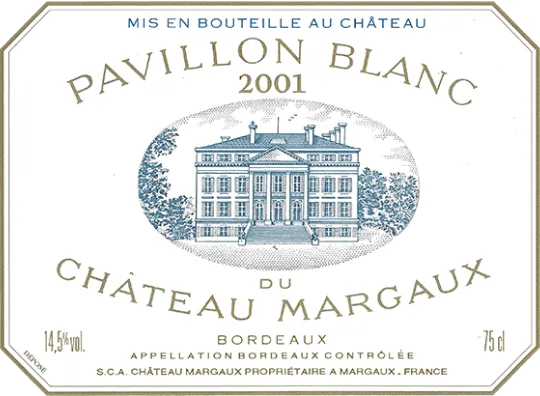
2001 is, along with 2004 and probably 2005, one of the greatest vintages of Pavillon Blanc. Never before had our wine achieved such a level of concentration, complexity and depth. On the palate, the richness, length, smoothness and, lastly, the freshness completely conceal the high alcoholic degree of 14.8°.
The bottles of 2001 are now at their peak, while the magnums, showing superb freshness, can be held for several more years (February 2025)
Climate
After a very rainy winter, the flowering went quickly and evenly. During the entire summer, there were unusually alternate periods of hot and cool, dry and wet weather, which encouraged vegetation growth and slowed ripening. We harvested eight days behind schedule but in fine weather. (The picking began on 1st October)
Pavillon Blanc du Château Margaux
2000
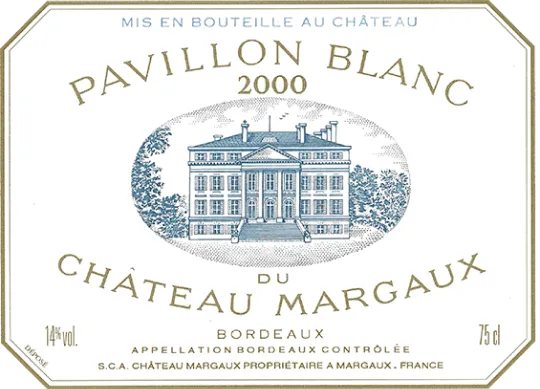
Throughout the summer, the weather conditions were hot and dry, but never extreme. The sauvignon blanc grapes therefore ripened perfectly, without reaching, however, the exceptional concentration or ripeness of the 1999 and 2001 vintages. We are not sure of the reason for these differences; in fact, the climatic factors, on which the ripening process depends, are still not completely understood. Pavillon Blanc 2000 is a wine of great aromatic elegance, and over 20 years after being bottled, it has developed real complexity even if it is missing a bit of concentration. To be enjoyed now, without waiting too much longer (October 2025)
Climate
April and May were warm and rainy, an early encouragement to downy mildew which was halted by the very dry summer. The absence of rain in August and at the beginning of September was very beneficial for the ripening process and the concentration in the grapes. A few light showers at the beginning of the harvest could not spoil this dream vintage. (The picking began on 25th September)
Pavillon Blanc du Château Margaux
1999
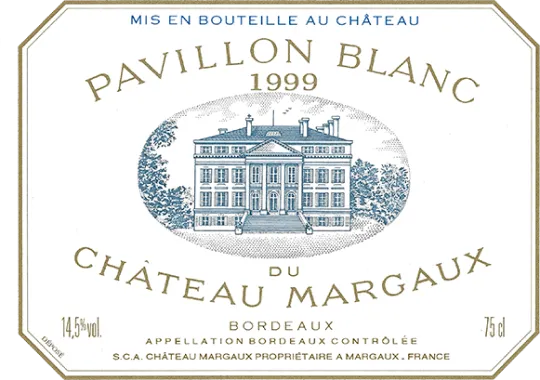
The rain arrived too late to affect the sauvignon blanc crop. It was therefore able to retain the high level of concentration and ripeness that it acquired in August and early September. Over twenty years after bottling, most of the bottles are tired while the magnums have retained a lot of freshness and show great complexity. (February 2025)
Climate
After an early flowering, the summer was hot and sunny, with isolated rainy spells: optimal conditions to the ripening of the grapes, but also to the onset of downy mildew. From 20th August to 10th September, the very dry weather brought the ripening and the concentration of the grapes to exceptional levels; then heavy rains came until the end of September. (The picking began on 22nd September)
Pavillon Blanc du Château Margaux
1998
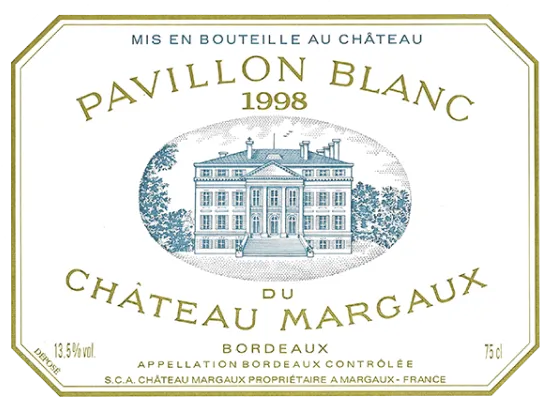
In 1998, we were fortunate to harvest the sauvignon blanc grapes before the heavy rain at the end of September and beginning of October. They had therefore taken full advantage of the exceptional weather conditions in August.
We recommend enjoying it without too much delay. (October 2025)
Climate
The dates for bud-break, flowering and colour change in the grapes correspond exactly to the averages. What distinguishes this growing season is the exceptional heat and drought during the month of August : the grapes acquired an excellent level of concentration early on. The heavy rain at the end of September came too late to cause significant dilution. (The picking began on 24th September)
Pavillon Blanc du Château Margaux
1997
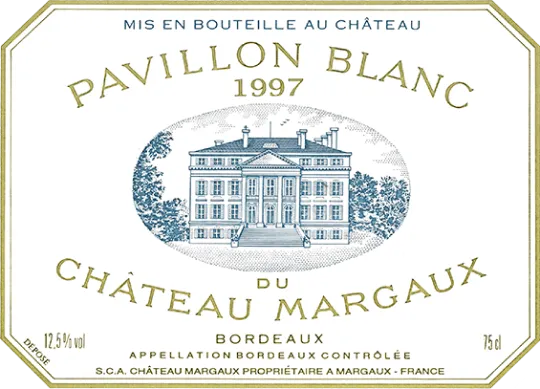
The warm, humid weather in August greatly favoured the onset of rot, in particular, acid rot, which was previously practically unknown in the Bordeaux vineyards. Fortunately, the hot and very dry month of September put a halt to this worrying development and enabled us to harvest well-ripened grapes in excellent conditions.
Pavillon Blanc 1997 shows an excellent balance between freshness and smoothness. The very ripe aromas of the sauvignon blanc and the elegance found in great vintages are clearly evident. Only concentration is lacking for it to be considered a great vintage. It is pleasant to drink now and we recommend drinking it without much delay. (March 2025)
Climate
After a particularly dry and warm start to the year and an early but long, drawn-out flowering, July was dry and hot and August was rainy and very hot, resulting in the threat of disease in the vines. Fortunately, at the beginning of September, hot and very dry weather set in until the end of the harvest. (The picking began on 15th September)
Pavillon Blanc du Château Margaux
1996
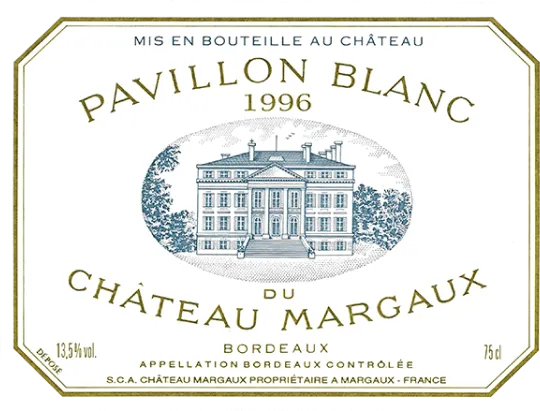
One of the greatest vintages of Pavillon Blanc! Never before have the grapes achieved such a high degree of sugar, and more generally, such concentration. This surprising result is certainly due to the very unique climatic conditions that prevailed at the end of the summer, both very dry and cool with a persistent north wind.
Pavillon Blanc 1996 is a particularly powerful and concentrated wine with amazing length on the palate. It is today remarkable for its freshness and complexity. We recommend drinking it, as it is so impressive. (February 2025)
Climate
After a very quick flowering, the summer was unsettled, with alternating periods of hot and cool weather and stormy showers, though less heavy in the Médoc than on the right bank. As from the 1st September, cool and very dry weather set in for three weeks. It then rained and fine weather returned for the harvesting of the Cabernets. (The picking began on 23rd September)
Pavillon Blanc du Château Margaux
1995
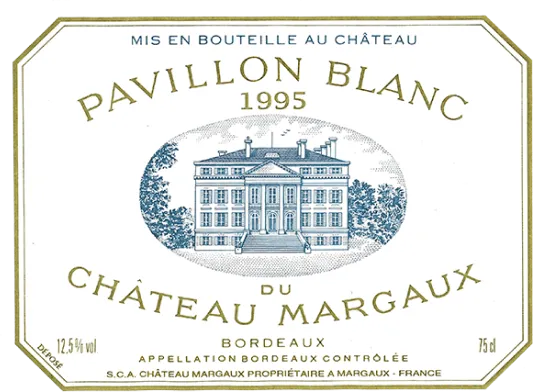
After an extremely hot and dry summer, the grapes reached an excellent level of ripeness and were partially harvested before the heavy rains of mid-September. The grapes picked immediately afterwards were of course perfectly ripe, but slightly diluted.
It is an excellent vintage of Pavillon Blanc, the most powerful since 1989. Pavillon Blanc 1995 is now reaching its peak. (February 2025)
Climate
After a very mild winter, the bud-break and flowering were early and even. The whole summer was one of a great vintage: hot and very dry. The quite heavy rain that arrived in the middle of September was without doubt of benefit to the ripening of the grapes. The weather was then superb throughout the harvest. (The picking began on 15th September).
Pavillon Blanc du Château Margaux
1994
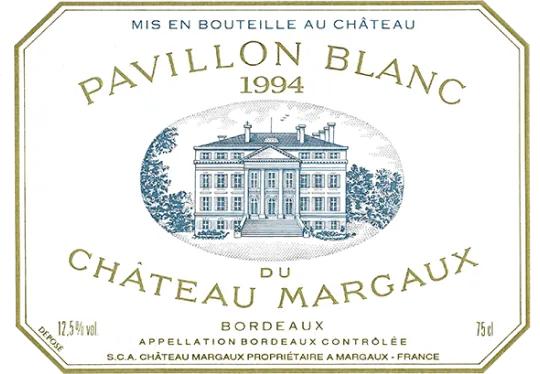
1994 is a somewhat austere vintage of Pavillon Blanc, long overshadowed by 1993, even though the conditions of the vintage were equally good. It has opened up remarkably in recent years, and we now recommend drinking it without waiting too much longer. (February 2025)
Climate
A particularly hot and dry summer and a very early harvest enabled the grapes to reach a remarkable level of concentration and richness. The heavy rain during the picking came too late to cause any real problems for the ripening of the grapes. (The picking began on 13th September)
Pavillon Blanc du Château Margaux
1993
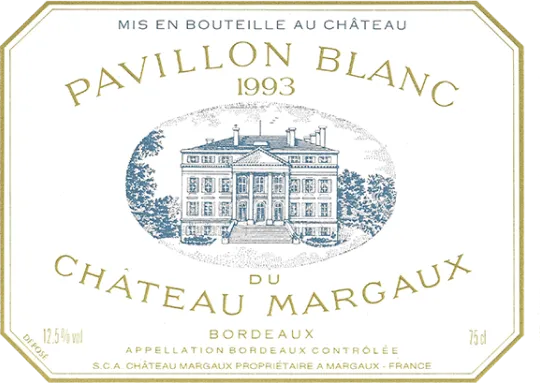
1993 is another example of a year in which better quality was achieved in white wine than in red, as the sauvignon blanc grapes were harvested earlier and were therefore less affected by the rain. It is even a great vintage of Pavillon Blanc which is showing remarkably well today; it combines plenty of freshness with the complexity of a well-developed bouquet. To be enjoyed now. (February 2025)
Climate
After an earlier than normal bud-break, the weather conditions were very favourable for the flowering, which was particularly fast and even. July was very dry but cool ; August was very hot and dry. On 10th September, the quality potential was remarkable. Unfortunately, the harvest was very rainy. (The picking began on 19th September)
Pavillon Blanc du Château Margaux
1992
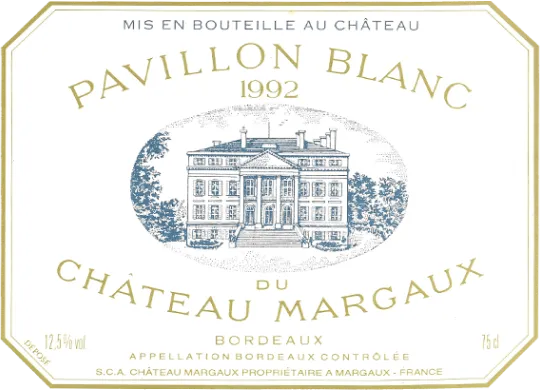
The Pavillon Blanc did not escape the adverse weather conditions of the 1992 vintage. It is quite light, slightly diluted, yet its development has been surprising. We did not actually expect it to develop such finesse and harmony. Today, this wine is very enjoyable to drink—not particularly complex or dense—but marked by lovely freshness. We do not think it can improve further and therefore recommend enjoying it now. (February 2025)
Climate
After a very dry winter, the weather was wet during the flowering, which was long and uneven. The summer was hot, but August was particularly rainy, which affected the health of the vines more than usual. Fine weather never really settled in after that. (The picking began on 29th September)
Pavillon Blanc du Château Margaux
1991
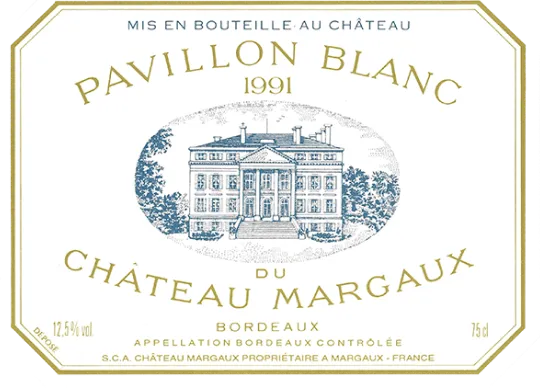
The rain slightly diluted the crop of red grapes, but the sauvignon blanc grapes, picked ten days earlier, were much less affected. 1991 is a very good vintage of Pavillon Blanc; it is quite powerful, fleshy and full. The bouquet has developed remarkably well and today displays great finesse and complexity, along with a certain originality. This wine should be enjoyed soon. (February 2025)
Climate
1991 was the year of the great spring frost on 21st April. The cold delayed vine growth until the end of May. But an extraordinarily hot, dry summer allowed the vegetation to catch up and brought this very small harvest to an excellent level of ripeness. Unfortunately, heavy rain just before the harvest took the shine off what would have been a remarkable vintage. (The picking began on 30th September)
Pavillon Blanc du Château Margaux
1990
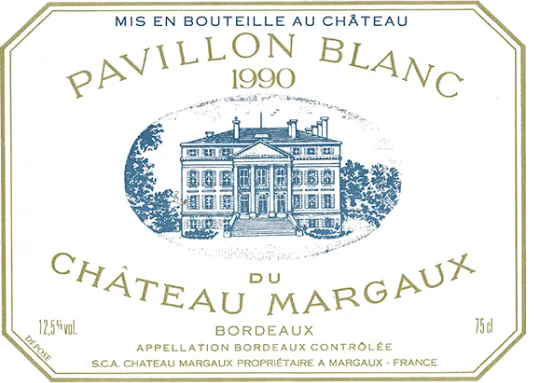
Marked by fairly significant bottle variation, Pavillon Blanc 1990 can also be remarkably fresh and complex, reminiscent of the wonderful 1989. It should be enjoyed without too much delay, though. (February 2025)
Climate
After a mild winter, the flowering was very early but quite long and uneven. As in 1989, the summer was exceptionally hot and so dry that at the end of August the young vines were really suffering from lack of water. The two rainy intervals in September were very beneficial to the final ripening of the grapes, which were harvested in very fine weather. (The picking began on 17th September)
Pavillon Blanc du Château Margaux
1989
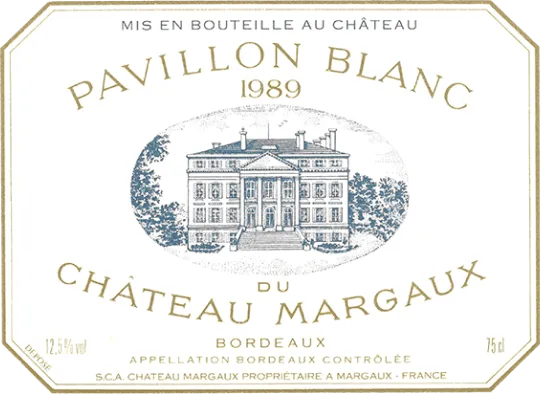
This is one of the greatest vintages of Pavillon Blanc. This was the first time, perhaps, that the sauvignon blanc grapes had reached such an exceptional level of ripeness, allowing them to rise above the vegetal aromas often considered typical of the variety. In fact, 1989 was the year we first introduced strict yield control in the white‑wine plots, which have not exceeded 30 hectolitres per hectare since. When weather conditions permit, this low yield favours both concentration and full ripening of the grapes.
Today, Pavillon Blanc 1989 is, without any doubt, fully mature and tasting remarkably well. We can only advise you to drink it. (February 2025)
Climate
1989 will long be remembered as an exceptionally early vintage and a very easy one, from a vine-growing point of view. The flowering, then the colour-change and the ripening all took place in perfect weather, which was particularly hot and dry. Finally, there was not one single day of rain during the harvest. From beginning to end, then, 1989 was a dream year. (The picking began 11th September)
Pavillon Blanc du Château Margaux
1988
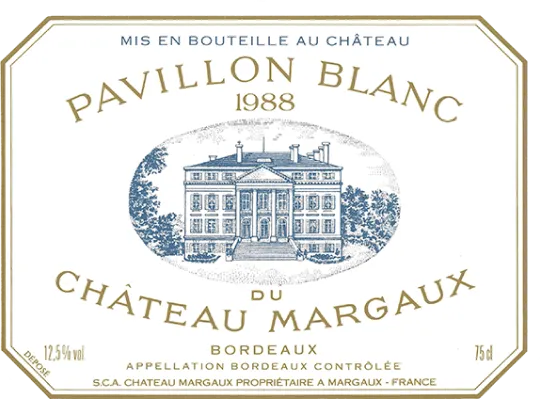
1988 is a great classic Bordeaux vintage, for the white wines as much as for the reds. Thanks to the hot, dry conditions in August and September, the sauvignon blanc grapes reached an excellent level of ripeness and were picked at the ideal moment, just before the light rains that arrived at the beginning of the red‑grape harvest. This vintage is now showing very well—fine, fresh, complex, sappy and quite lively. It should nevertheless be enjoyed without too much delay. (February 2025)
Climate
After a very mild winter and a wet spring, June and the beginning of July were particularly rainy. Then, from mid-July onwards, until the end of September, hot and very dry weather set in. Despite a few light rain showers at the beginning of the harvest, the picking was carried out in excellent conditions. (The picking began 3rd October)
Pavillon Blanc du Château Margaux
1987
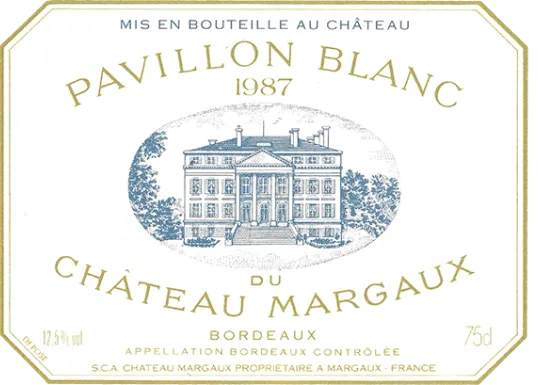
A rather light but fine vintage of Pavillon Blanc. Generally speaking, the white wines performed better than the reds in the Bordeaux region, as the harvest was finished before the October rains set in. To be enjoyed now. (October 2025)
Climate
The weather was unsettled for the whole year. Hot weather and dry conditions never really set in, except for a ten-day spell in September, when it was very hot. The harvest began relatively late in difficult conditions with frequent rain showers. Fortunately, the weather was cold, which prevented any rot from developing. (The picking began 5th October)
Pavillon Blanc du Château Margaux
1986
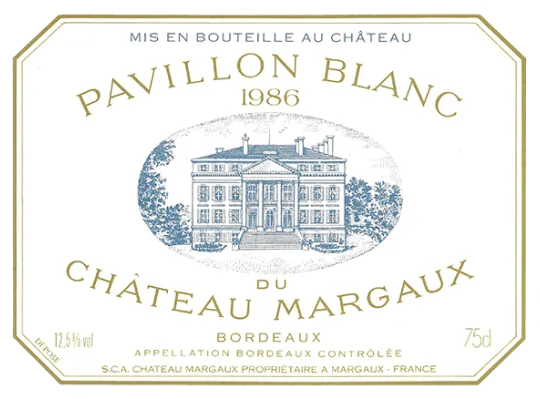
A great vintage of Pavillon Blanc, perfectly combining power and depth with elegance and freshness. Almost 40 years after its bottling, it is still amazingly fresh and complex. This wine offers a fine demonstration of the ability of Pavillon Blanc to improve in bottle while keeping its freshness. To be enjoyed now, though there is no rush. (October 2025)
Climate
The very fine summer weather was hardly affected by the brief spell of rain around 20th September, which in the end, may have been more beneficial than we first thought. Immediately afterwards, the fine weather came back and stayed with us for the whole of the harvest time, bringing the grapes to superb ripeness. (The picking began 1st October)
Pavillon Blanc du Château Margaux
1985
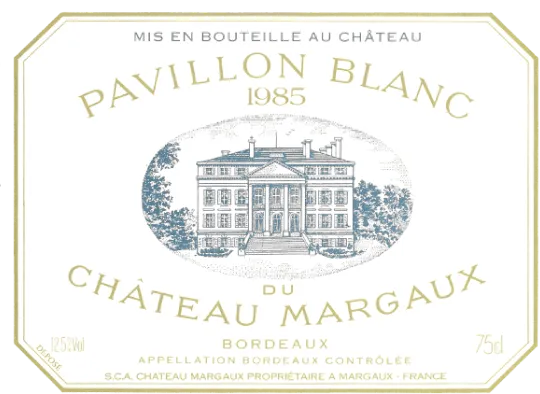
This was a difficult vintage for Pavillon Blanc, which never really had much charm; however its power and concentration have enabled it to age with some fortune. It nevertheless should be drunk immediately. (October 2018)
Climate
After a quite cool and late start to the growing season, this vintage was influenced by very advantageous ripening and harvesting conditions, especially during the months of September and October, which were very hot and dry. The leaves on the vines refused to fall until late into November. This Indian summer will be remembered a long time. (The picking began on 26th September)
Pavillon Blanc du Château Margaux
1984
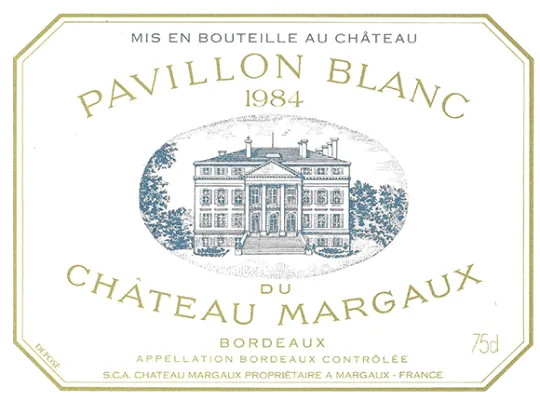
A challenging vintage for the white wine. The crop was quite large and ripeness was only just achieved. Pavillon Blanc 1984 has always been slightly diluted, yet fine and delicate. It certainly lacked a little concentration and complexity to really improve in bottle. It should have been drunk by now, but the bottles that remain are far from having passed their prime. (October 2025)
Climate
The cold and rainy weather during the flowering caused the worst case of "coulure" in history, i.e. preventing the flower from setting into fruit. Summer was quite hot and sunny, but heavy rain in September hampered the ripening of the grapes. Fortunately, the harvesting was carried out in sunshine, which enabled us to bring in sufficiently ripe grapes in this difficult vintage. (The picking began 1st October)
Pavillon Blanc du Château Margaux
1983
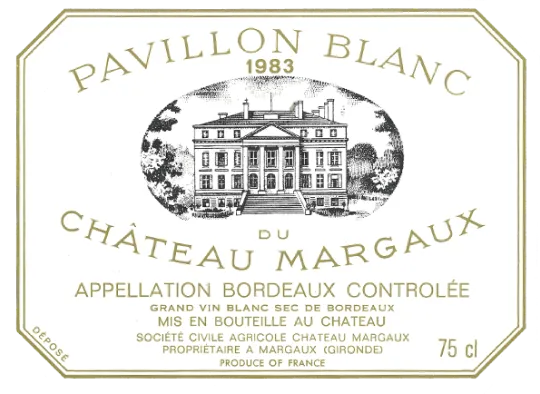
The exceptional conditions in the late season also allowed for an outstanding vintage of white wine, whose quality—like that of the red—is comparable to the 1982 vintage.
1983 once again proves that in very good vintages, Pavillon Blanc du Château Margaux has excellent potential to improve in bottle. Many bottles remain remarkable for their freshness and complexity. (February 2025)
Climate
After a very rainy spring, the month of June was hot and dry, making excellent conditions for the flowering. The summer was hot and humid, almost tropical, thus causing potential risks of disease. Then, as from the 10th September, very fine hot and sunny weather set in, helping the grapes to reach excellent ripeness levels. (The picking began on 29th September)
Pavillon Blanc du Château Margaux
1982
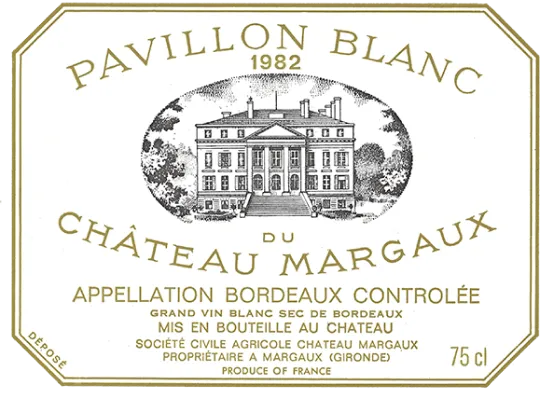
A particularly severe and late frost on May 10th drastically reduced the potential crop size. The following year, we installed our frost‑protection system… Thanks to the exceptional weather conditions that followed during the spring and summer, a second generation of clusters — smaller in quantity — was able to reach very good ripeness.
1982 immediately proved to be the finest vintage of Pavillon Blanc in a very long time. For the first time, we achieved not only great aromatic finesse but also remarkable power on the palate, which has allowed the wine to evolve beautifully in bottle. To be enjoyed now. (October 2025)
Climate
Throughout the whole year, the weather conditions were very favourable for the vines and for the ripening of the grapes. After an early flowering, the summer was particularly hot, especially in July and during the first two weeks of September. The grapes reached outstanding ripeness levels with, among other feats, a record concentration in sugar. (The picking began 20th September)
Pavillon Blanc du Château Margaux
1981
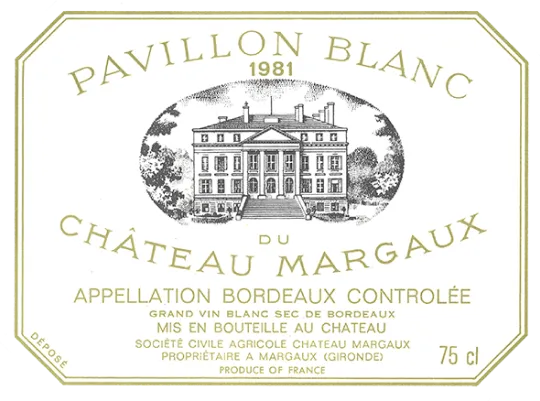
A fine vintage from the beginning. The wine's evolution in bottle has confirmed our hopes, allowing it to develop that complexity and finesse which belong to only the greatest white wines. Some bottles are still remarkable. (February 2025)
Climate
The four previous years had been late harvests; 1981 then, was the return to a classic harvesting date. The flowering went quickly and evenly, August was very hot and dry, and after a few rain showers in September, the weather was very good for the whole of the harvest, which began on 1st October.
Pavillon Blanc du Château Margaux
1980
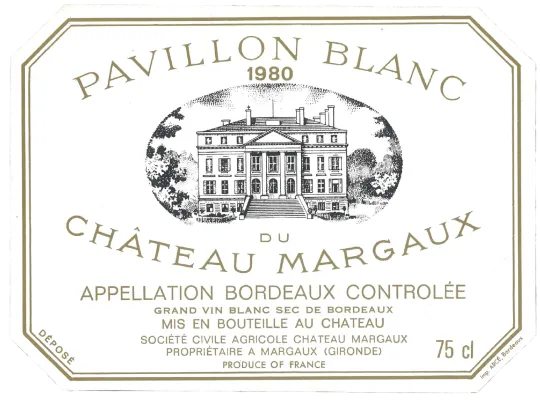
We inaugurated, for the 1980 harvest, the new white wine cellar, located in the Abel Laurent outbuildings between Château Margaux and the village of Margaux. This cellar, designed with the advice of Emile Peynaud, included an air‑conditioned room where all the barrels of the harvest could be stored. This made it possible both to control the temperature during fermentation and to accelerate tartaric precipitation over the winter.
1980 is one of Pavillon Blanc’s lesser vintages, both in terms of quantity and quality. Yet, as is often the case, bottle ageing has allowed it to acquire a complexity that was not initially expected, even if today it would ideally already have been consumed. (October 2025)
Climate
A disastrous cold, rainy spring held back the flowering, which only took place at the end of June. There was mixed weather in the summer, but fortunately September was sunny and hot. After a rainy start to October, dry, cold weather set in, enabling us to harvest, albeit very late, sufficiently ripe and perfectly healthy grapes. (The picking began 17th October)
Pavillon Blanc du Château Margaux
1979
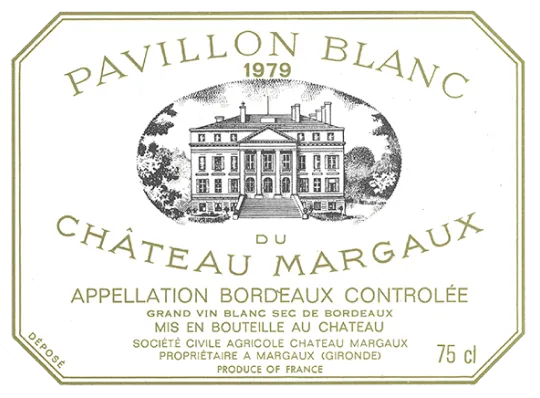
For a long time, this wine had the "classic aromas" of Sauvignon Blanc, that is a little herbaceous. With time, the nose has become much more complex, and the wine has not lost its freshness. It is a perfect example of a wine improving through bottle ageing. The majority of the bottles are now tired, but some maintain a remarkable freshness. To be enjoyed now. (February 2025)
Climate
The weather conditions were very similar to those in the 1978 vintage: a wet spring, a hot summer in July and cool in August; and a very fine end to the summer. Once again, the grapes just managed to reach a very good level of ripeness. (The picking began 4th October)
Pavillon Blanc du Château Margaux
1978
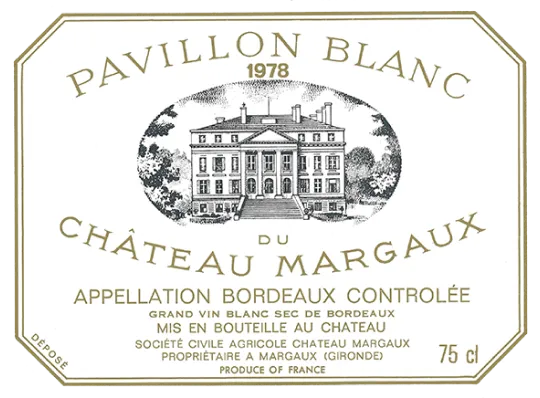
1978 was the first vintage to benefit both from the consulting of Emile Peynaud and from very careful, precise vinification in barrel. The best bottles still have a wonderful freshness, which is reflected in their almost unchanged colour. Of course, the aromas have developed and bear the mark of this long ageing in bottle, but it is astonishing to find so much vivacity in a sauvignon blanc wine after so many years. To be enjoyed now. (February 2025)
Climate
The time lost through a particularly cool and wet spring was never made up during the summer, but an exceptional Indian summer enabled sufficiently ripe grapes to be picked in perfectly healthy condition. (The picking began on October 9th)
Through the vintages
Rediscover the Pavillon Blanc du Château Margaux through its vintages
Select your year
Pavillon Blanc du Château Margaux
2025
The harvest for Pavillon Blanc 2025 took place very early, between August 18th to 22nd, when the grapes were at optimal ripeness, thereby preserving their acidity, freshness and aromatic complexity. This vintage has a similar balance to 2022.
The nose is deep, offering notes of fresh hazelnut, white peach and lilac. On the palate, the wine is rich and full-bodied, while at the same time retaining a delightful freshness. The salinity brings liveliness and length, making for a harmonious, persistent expression.
However, volumes were among the lowest in the last fifty years, with yields of just 16 hl/ha. Only 45% of the harvest was selected for the Pavillon Blanc 2025 blend. Sadly, this was the smallest number of bottles we have ever produced.
Blend: 100% sauvignon blanc.
Climate
Le millésime 2025 est marqué par une saison contrastée, avec un printemps doux et équilibré, sans excès ni déficit, suivi d’un début d’été et d’une période estivale plutôt secs, rappelant le profil de 2022. Le débourrement intervient avec une semaine d’avance, précocité que l’on retrouve également dans la floraison. Celle-ci se déroule de manière rapide et homogène, dans des conditions climatiques particulièrement favorables, sans coulure ni millerandage.
La pluviométrie reste faible au début de l’été, installant progressivement un déficit hydrique. Le mois d’août est dominé par un épisode caniculaire, entraînant une accélération des maturités, notamment sur le sauvignon blanc.
En fin d’été, près de 60 mm de précipitations tombent entre fin août et début septembre. Ces pluies, attendues, apportent un rééquilibrage hydrique et une baisse des températures, permettant une maturation plus régulière et homogène en fin de saison. Malgré quelques épisodes pluvieux ponctuels en septembre, les conditions sanitaires demeurent très bonnes.
Dans ce contexte climatique, le choix a été fait de ne pas avancer les dates de vendanges afin d’atteindre une maturité optimale, en particulier phénolique. Cette décision, assumée mais engageante, a permis d’atteindre un niveau de qualité particulièrement élevé, avec des raisins récoltés à parfaite maturité, exprimant pleinement le potentiel du fruit et du millésime.
Pavillon Blanc du Château Margaux
2024
The Pavillon Blanc harvest took place between the 2nd and 8th of September, slightly later than in recent years. Harvest conditions were ideal, with no health issues in the vineyard, enabling us to harvest at a calm, steady pace. The mild summer temperatures and absence of heat spikes favoured gradual ripening, preserving the balance between freshness and concentration. As always, our teams started early in the morning to harvest the berries at the coolest possible temperatures for optimal preservation of their aromas and flavours. On our 11 hectares dedicated to sauvignon blanc, plot selection plays a key role in the wine’s production. All our white grape plots are harvested and vinified separately in the modern winery designed by Norman Foster. Conceived to combine precision and excellence, these winemaking facilities allow each batch to be treated with meticulous care, further refining our quest to achieve the purest possible expression of sauvignon blanc. In our pursuit of perfection, we have applied even more rigorous standards. In recent years, less than half of the harvest has been used for Pavillon Blanc du Château Margaux with the remainder going to the Pavillon Blanc Second Vin. This enables us to further refine the Pavillon Blanc style.
Climate
Weather factors impacting the 2024 vintage began in 2023 with exceptional amounts of rain. From autumn onwards, there was an unusually intense accumulation of rainfall for several months. Between the 18th of October and the 28th of March, more than 1,000 mm of rain fell in the vineyard, surpassing the previous record for rainiest vintage by 300 mm. With mild winter temperatures, 3°C higher than historical averages in March, the abundance of water and warmth provided ideal conditions for the vines to start their growth cycle well ahead of schedule. Bud break occurred between the 22nd and 25th of March, 7 to 10 days earlier than in recent years. However, the wet weather continued, setting the pace for the entire growing season. While some past great vintages, such as 2000, had similar rainfall, what set 2024 apart was the frequency of rainy days. Access to the plots became a constant challenge, and the omnipresent threat of downy mildew meant that teams had to remain vigilant at all times. In this challenging context, flowering was slightly delayed, spanning from the 31st of May to the 7th of June.
Véraison, when the grapes change colour, took place between the 9th and 23rd of August, and was reminiscent of vintages such as 2014 and 2016, confirming a growth cycle significantly influenced by wet weather. Faced with these conditions, the vines reacted in contrasting fashions. Plots with very cool, deep soil suffered from downy mildew, particularly affecting the volumes destined for our third wine, Margaux du Château Margaux. Conversely, our gravelly terroirs, with better drainage and earlier ripening, were able to preserve their potential and produce some of the finest grapes of the vintage.
While the weather conditions put the vines to the test, they did not compromise the exacting stan - dards and precision with which our teams work on every Château Margaux vintage. With an average yield of 30 hl/ha, the sorting carried out by our pickers in the vineyards was more rigorous than ever, highlighting the most resilient terroirs and offering an optimal balance between concentra - tion and finesse.
Pavillon Blanc du Château Margaux
2023
The Pavillon Blanc harvest took place between September 2nd and 8th, slightly later than in recent years. Harvest conditions were ideal, with no health issues in the vineyard, allowing us to work at a calm, steady pace. The mild summer temperatures and absence of heat spikes favoured gradual ripening, preserving the balance between freshness and concentration. As always, our teams began early in the morning to pick the berries at the coolest possible temperatures for optimal preservation of their aromas and flavours. On our 11 hectares dedicated to sauvignon blanc, plot selection plays a key role in the wine’s production. All our white grape plots are harvested and vinified separately in the modern winery designed by Norman Foster. Conceived to combine precision and excellence, these winemaking facilities allow each batch to be handled with meticulous care, further refining our quest to achieve the purest possible expression of sauvignon blanc. In our pursuit of perfection, we have applied even more rigorous standards. In recent years, less than half of the harvest has been used for Pavillon Blanc du Château Margaux, with the remainder going to the Pavillon Blanc Second Vin. This enables us to further refine the Pavillon Blanc style. (November 2025)
Climate
The winter of 2022-2023 was relatively mild, although there were about ten days of real winter temperatures in the first half of February.
There was also not much rain during the first few months of 2023: 196 mm in Margaux, allowing only a very light replenishment of groundwater reserves after an extremely hot, dry 2022 vintage. In these conditions, bud break occurred between the 3rd and the 10th of April.
Fortunately, spring did not bring any of the feared frosts. Rain was sparse but frequent during the growing season. There were just two weeks of sustained rain in June (72 mm). However, these conditions made it potentially difficult to keep the vines healthy. The high relative humidity in the air created very favourable conditions for downy mildew. Our vineyard teams succeeded in main¬taining healthy foliage to ensure good-quality ripening of the grapes and a successful harvest.
The vines flowered between the 31st of May and the 5th of June in good conditions, with no signs of coulure or millerandage.
2023 was markedly different from the previous vintage in terms of temperature. In 2022, there were very early heatwaves. In 2023, we had just one real heatwave, between the 17th and the 24th of August, the period when the grape skins mature, becoming thinner and more sensitive to the com-bined action of high temperatures and sunshine. The berries that were most exposed to the sun suffered scalding, forcing us to do a lot of sorting during the harvest.
Pavillon Blanc du Château Margaux
2022
The white harvest took place from August 23rd to the 30th. High temperatures in the last ten days of August meant that we had to pick the grapes earlier to retain all their potential acidity, which is so important in white wines. We even had to bring forward the picking times, starting in the early hours of the morning and finishing at midday.
We were determined to preserve the intensity and aromatic complexity that characterise our white wines, and to spare the pickers from working in the excessive heat.
We drew the best from our Virefougasse plots to craft a wine with complex flavours and aromas, and a well-rounded palate. Plot selection was even more rigorous in the vineyards. The grapes harvested from almost ten hectares were vinified in around twenty different batches. The trials undertaken over several years to create the second white wine, the Pavillon Blanc Second Vin, and its launch with the 2022 vintage have allowed Pavillon Blanc to become even more precise. (November 2025)
Climate
The description of the weather conditions has begun the same way almost every year for the last ten years: 2022 was once again the hottest year on record... and to this, we must add another climate phenomenon: a severe drought. However, these two factors impacted the harvest in such a way as to produce an extraordinary vintage.
Apart from some frosts in mid-January, the winter of 20x22 was mild and relatively dry, with just 150 mm of rain. Nationally, the spring of 2022 was the third warmest (13.2°C) since 1900, close behind 2011 and 2020. It was the same in Margaux, with record temperatures during June, sometimes exceeding 40°C. Fortunately, in typical Bordeaux fashion, there was regular rain throughout the spring, with 182 mm in Margaux. Summer brought further extremes: three long, intense heat waves; the thermometer again recorded temperatures over 40°C several times, and over 35°C for more than 14 days in July and August. Slightly more than six long weeks passed without a single drop of rain. The 20 mm that arrived at the end of August was welcome, but its effect was more to cool the air than to significantly rehydrate the surface soil.
In these conditions, budburst was relatively spread out, between March 28th and April 13th, depending on the grape variety and the nature of our diverse terroirs. Conditions were sufficiently good that no coulure or millerandage was observed in our plots during flowering, which took place in the week of May 24th, indicating an early vintage.
The summer weather then reinforced the early nature of the vintage. The white grape harvest took place extremely early, on August 18th.
For the red grapes, it lasted from September 8th to 27th, with normal temperatures in September and optimal harvesting conditions. The first autumn rains began on the last day of the harvest.
Pavillon Blanc du Château Margaux
2021
For this vintage, as with other recent hot, dry vintages, acidity was the key parameter that determined the beginning of the harvest. And it was this acidity that decreased very rapidly between early and mid-August. Thanks to the determination and professionalism of the team at the property, we were able to react quickly to start the harvest exceptionally early.
As with the red grapes, the Sauvignon Blanc berries were smaller, as were the bunches—perhaps a consequence of the spring frosts in 2021—and so yields were disappointing. However, the quality of the vintage and its relative uniformity allowed us to use 50% of the white grapes for the Pavillon Blanc blend. The aromatic precision is tremendous. Pavillon Blanc 2022 has a delicate, balanced mouthfeel.
It must be said that while every vintage brings new answers and teaches us something, it often also raises its fair share of questions. Sometimes we learn a little, and often we wonder a lot. Even if we do not completely understand it, this vintage is reassuring. Who could have imagined that such weather conditions could produce such well-balanced wines? (April 2025)
Climate
The winter of 2021 was relatively mild, although quite wet, with more than 230 mm of rain falling in the first two months of the year. With the month of March being drier and warmer, our vines flowered between the 23rd and the 30th of the month. Spring was marked by frequent and severe episodes of frost, testing the frost protection sprinkling systems on our white grape vineyards like never before. Temperatures fell so drastically that we lost close to a hectare's worth of our white harvest. On the other hand, our red grape vineyards were less affected by the cold, with only a few vines hit by some morning frost.
May and June recorded quite a bit of rainfall, and we had to be watchful to prevent the spread of fungal diseases. The determination of our team eventually paid off and we were able to maintain the grapes and leaves in good health. Budbreak occurred between the 1st and the 6th of March in average conditions, however the fruit-set was excellent, with only a few of the older plots falling prey to coulure or shatter.
After a rainy month of July, August and the first half of September were extremely dry. Just after we had finished picking the white grapes, we had about 45 mm of rain, raising concerns of a poor red harvest.
As in the 2017 vintage, we were faced with the following choice: pick grapes that were not fully ripe before they could potentially be attacked by Botrytis, or wait till the end of September to harvest the grapes when they would be riper and more concentrated from the additional sunshine. And as in that year, the decision was made to prioritise the quality of the grapes. The early Merlot plots were harvested on the 24th of September while the later Cabernet harvests only began by the 4th of October. The harvest was completed by the 13th of October. The season definitely presented its fair share of challenges, but the quality of our work and attention ensured we had an elegant and dense vintage.
Pavillon Blanc du Château Margaux
2020
The white grape harvest took place between September 7th and 13th, a little later than the average over the last ten years. As the acid potential of the vintage was high, acidity was not the only parameter in determining the harvest date: several other factors were equally important, such as the aromatic potential of the berries and their complexity upon tasting. The dates of the harvest were also planned to avoid the rains forecast for the second half of September. The grapes were in perfect health and above all, the juice concentration was excellent.
The Pavillon Blanc blend represents 52% of the 2021 harvest and is sumptuous on the palate. Perfectly balanced, with a rich and complex concentration, this wine opens with a creamy texture and has a fresh acidity that lends it an enduring, long finish. Its quality level is probably comparable to the 2017 vintage and will likely require some patience before reaching its peak. (November 2025)
Climate
As in the preceding vintages, 2020 saw average temperatures that were among the highest ever recorded due to a series of heatwaves and an exceptionally dry summer.
After abundant rainfall at the end of 2019, there was very little rain in the first quarter of 2020, 80 mm (3.15 inches) less than the thirty-year average. Winter 2020 stood out for its mild temperatures. Average temperatures were 3°C (37°F) above the thirty-year average and temperatures in February sometimes exceeded 20°C (68°F). Only four light frosts occurred in what was otherwise a mild winter. As a result, bud break was extremely early, from the 22nd to the 26th of March depending on the grape variety, approximately ten days earlier than average. The 2020 vintage promised to be an early one.
The spring was also very mild. Temperatures in April were among the hottest since 1962. Flowering occurred between the 21st and the 26th of May, in excellent conditions. There were no signs of coulure or millerandage. The spring was particularly wet, which meant a greater risk of disease that we nonetheless managed to control (very few signs on the leaves and none on the bunches).
The summer brought long and intense heatwaves between the 23rd of June and the 12th of August, as well as significant drought, with no rain at all between the 19th of June and the 10th of August. Ripening occurred between the 23rd and the 26th of July. It was only during the second ten-day period of August that rainfall helped limit potentially excessive hydric stress. Nearly 80 mm (3.15 inches) of rain fell on August 13th. In spite of the thunderstorms that followed, the rainfall did not significantly penetrate the soil. However, the storms did cause the temperature to decrease and limit sun exposure thus contributing to maintaining good acid potential in the berries.
Conditions in September were also ideal for the grapes, with glorious sunshine by day, cool nights and only 14 mm (0.55 inches) of rain. We began to harvest our early Merlots on September 10th. There were just a few days in mid-September when it became too hot to harvest during the afternoon. The harvest began on a larger scale on September 21st when all our grape-pickers arrived and immediately began picking our Cabernets. The harvest ended on September 30th.
Pavillon Blanc du Château Margaux
2019
The white grapes were harvested from September 2nd to the12th under perfect conditions. For nearly five years, in partnership with our R&D team, we have been working in our vineyards to adapt yields to our terroirs, while maintaining the hallmark style and quality of Pavillon Blanc. Size was naturally a critical factor in achieving our goals. The number of bunches was thus adapted for each vine, and two passes were made during the harvest to pick each bunch at optimal maturity.
The sanitary state of the vineyard was very good and despite the summer conditions, the vines showed few significant signs of hydric stress. We simply needed to carefully and meticulously monitor the balance between sugars and acidities to decide on the best harvest date.
Pavillon Blanc 2019 is an elegant, delicate and fresh wine, and in some ways reminiscent of the 2017 vintage. The aromas are similarly precise, intense and complex. It is already delicious, although we recommend waiting a little longer. (October 2025)
Climate
Globally, 2019 was the warmest year on record. In France, the average temperature was 13.7°C, 1.1°C to 1.2°C higher than usual.
In Margaux, the winter of 2019 was mild at 1 to 2 degrees above the 30-year averages, with limited rain (30 mm less than the 30-year averages) and only three days of frost. Under these conditions, the date of bud-break ranged from March 29th to April 4th.
Spring was mild and temperatures were near-normal for the season, with abundant rainfall at the end of April and again between June 5th and June 18th. Flowering occurred between the 1st and the 9th of June and went relatively well. Only some older parcels of Merlot showed some signs of coulure. The rain, which risked causing occasional outbreaks of mildew, had no sanitary impact and the vineyards remained in a very good state throughout the year.
The summer stood in sharp contrast to the rainy spring. Anticyclonic conditions prevailed and only 64 mm of rain fell between June 21st and September 21st. However, the summer of 2019 will be best remembered for two heatwaves at the end of June and then from July 22nd to 24th when the temperature reached 39.9°C in Margaux!
The red grape harvest began on September 18th in ideal conditions, and the Merlot grapes were perfectly ripe and concentrated when picked. A weather disturbance between September 22nd and the 29th did not affect the health of the grapes and allowed them to ripen more slowly under conditions that were less aggressive for the vines, better preserving the acidity levels, with ultimately not too high levels of alcohol. The grapes picked between the end of September and the beginning of October benefited from the concentration developed after veraison (August 5th to the 10th), without being significantly affected by low slight dilution from the rain.
The harvest ended on October the 10th.
Pavillon Blanc du Château Margaux
2018
We all know how much the harvest date influences a wine’s aromatic and structural profile. In order to select the "right time" to harvest, we pay close attention to the current physiological indicators. In 2018, considering the relatively high water stress in our Virefougasse vineyards and long periods of sunshine, acidity was the key parameter in our decision. Our aim is to add freshness to our Pavillon Blanc and thus give it every chance to age well over time. The sun, combined with low yields, allowed the grapes to achieve satisfactory sugar levels, leading to pleasant and complex aromas. The harvest was early, from August 27th to 31st. Although our aim remains to choose the best batches from our vineyard selections, tasting revealed greater homogeneity, and we were able to use a higher proportion of batches than for previous vintages, with almost half of the harvest making up the Pavillon Blanc 2018. This vintage, for which the weather conditions seemed less favourable to the production of fine white wines than in 2017, is a major success due to the exceptional balance between richness, freshness, tension and minerality. It is already delicious to drink but will continue to improve for several years. (October 2025)
Climate
The warmest year since the beginning of the 20th century, temperatures in 2018 were 3.24°F above the national average. In Margaux, the year began with a relatively mild winter with below-normal temperatures and occasional frosts in February which had no impact on our vines. The rest of the year was hot, sometimes very hot, compared with seasonal averages, marked by record-breaking temperatures in the last ten days of June and the first ten days of August, more than 7.2°F above the 30-year average.
Rainfall in the first half of the year was heavy with nearly 25 inches in Margaux between January 1st and July 10th, making growing conditions challenging. Each rainy day made a good vintage less likely. But dry and warm summer conditions eventually reached our region and remained until the end of the harvest. Rainfall was very low between mid-July and late September at 2 inches. This rainfall pattern is reminiscent of 2009.
Under these conditions, budbreak was relatively late between the 4th and the 10th of April. The vines flowered between the 25th and the 28th of May and, despite fairly poor conditions, we did not note, even in the relatively sensitive Merlot plots, poor or failed fruit-set. The greatest challenge was mildew which this year led to slightly lower yields than hoped for after the fruit-set.
The white grapes were harvested the week of August 27th. The red harvest took place from September 17th to October13th in ideal conditions. Again this year, we were able to choose the best time to harvest our grapes – no Botrytis symptoms, mild weather, ripening conditions sufficiently spread between the earliest Merlots and latest Cabernets – and we had time to take the necessary care with each wine-making vat. Nearly a hundred different batches were converted into wine this year, demonstrating our continued efforts for better and more precise selections.
Pavillon Blanc du Château Margaux
2017
Despite the intense cold snap (a low of -6°C/21.2°F on the night of April 27th), our plots of sauvignon blanc were completely saved thanks to our frost-protection sprinkler system.
The precocity of sauvignon blanc (harvested between August 28th and September 5th) allowed it to avoid the end-of-the-season rains. The sanitary condition of the grapes was perfect, and the summer weather enabled them to ripen under the best possible conditions. The sugars concentrated while retaining the acid potential necessary for the balance of a great white wine.
We drew the very best from our Virefougasse plots to craft a wine with complex aromas, a round entry on the palate, and an endless finish carried by delicate notes of citrus and white flowers. This vintage also marks two important developments: the adoption of Diam technical corks, ensuring greater consistency in ageing, and the switch to a darker glass bottle, offering enhanced protection from light. It can already be enjoyed, although ideally it should be given a little more time. (November 2025)
Climate
After a relatively dry 2016, the first months of 2017 brought the necessary precipitation to keep the water table balanced. Winter temperatures weren’t particularly cold. The vines budded around April 4th, but we weren’t wary enough of the spring-like temperatures and a frost on the nights of April 27th and 28th served as a reminder that, above all, winegrowers are dependent on nature. The choice location of our vineyard plots allowed us to limit frost damage: only 10% of our red vines were affected.
In the whole growth cycle, only the last week of June saw heavy rainfall. The vines had already flowered between May 25th and 30th in the most favorable conditions for efficient, homogeneous pollination. Summer 2017 more or less resembled summer 2016: warm and very dry through July and August. Light rainfall in early September was the only thing that disrupted a rare opportunity to produce a third great vintage after 2015 and 2016; we had just harvested our white grapes when heavy precipitation dashed our hopes of a truly standout year.
We then had to make a crucial decision: to harvest quickly grapes that were not yet ripe enough for fear that Botrytis would ruin them, or wait for the sun’s return and harvest riper, more concentrated grapes later in September. In keeping with our high standards of quality and reassured by optimistic weather forecasts, we chose the latter and harvested the reds between September 12th and October 3rd in exceptionally fine weather conditions.
Pavillon Blanc du Château Margaux
2016
The white harvest took place from September 8th to the 13th. The acidity level declined quickly due to the beautiful sunny days at the beginning of the month. We know the extent to which acidity is necessary for the freshness and ageing ability of a white wine; the decision to harvest quite early was probably even more decisive in shaping a very good vintage of Pavillon Blanc.
Selection of our wines at the point of blending remains strict, with only a third of the harvest going into Pavillon Blanc 2016. The aromas of this wine are complex and very fine. The entry on the palate is round and pleasant, the prelude to a long, fresh finish, both mineral and fruity.
It fits perfectly into the lineage of the latest vintages, perhaps even presenting a little more richness on the palate. It is difficult to resist today, but will continue to gain in complexity in the years to come. (October 2025)
Climate
The wet and relatively mild winter led to quite early sprouting in the last week of March. The 400 mm of rain during the first 3 months of the year helped to replenish the ground water after a rather dry 2015. The spring rains came very close together and thus gave the impression that they had been plentiful, whereas in fact, the total of all the rain only amounted to the average of the last 30 years. The vines nevertheless managed to find a few rare, beautiful sunny days to blossom between June 6th and 8th.
The contrast with the summer drought was just as striking. Only 8 mm of rain fell during July and August. Even though the very young plants showed a few marked signs of hydric stress, our old vines behaved perfectly, once again demonstrating this species’ incredible capacity to adapt to the climate. Although dry, the summer wasn’t exceptionally hot. Only the second half of August was marked by higher than normal temperatures. The combination of these factors caused the colour change to be quite spread out. September, with its dry days and cool nights, enabled the grapes to complete their ripening process in optimal conditions.
The harvest of the reds, which was the most staggered in the history of the Estate, took place from September 23rd to October 18th.
All through the summer, with every passing day, we felt a little more excited at the thought of a great new vintage taking shape…
Pavillon Blanc du Château Margaux
2015
The white harvest took place from September 8th to the 13th. The acidity level declined quickly due to the beautiful sunny days at the beginning of the month. We know the extent to which acidity is necessary for the freshness and ageing ability of a white wine; the decision to harvest quite early was probably even more decisive in shaping a very good vintage of Pavillon Blanc.
Selection of our wines at the point of blending remains strict, with only a third of the harvest going into Pavillon Blanc 2016. The aromas of this wine are complex and very fine. The entry on the palate is round and pleasant, the prelude to a long, fresh finish, both mineral and fruity.
It fits perfectly into the lineage of the latest vintages, perhaps even presenting a little more richness on the palate. It is difficult to resist today, but will continue to gain in complexity in the years to come. (October 2025)
Climate
Winter, which was appreciably colder than those of the previous years, caused late, but perfectly regular blossoming. Dry and sunny weather in the spring made for optimal conditions, so flowering took place very quickly and homogenously. This hot, dry weather persisted throughout the months of June and July, to a point where we were afraid there could be water stress, at least in the most sensitive plots. Fortunately a little rain in August arrived just in time to ensure a quick and regular colour-change. The drought, which arrived again in September, together with very warm days and cool nights, enabled the grapes to balance their richness in sugar with good acidity, to render their tannins more silky and to make their aromatic potential more complex.
The harvest of the reds took place from September 18th to October 6th. The small size of the grapes and their thicker skins indicated a very high concentration of tannins. The 2015 weather conditions are, in fact, the feature of very great vintages, like 2005, 2009 and 2010.
Pavillon Blanc du Château Margaux
2014
In 2013 the precocity of the sauvignon blanc was more of an asset than usual because the grapes were able to achieve full maturity before the botrytis started to seriously develop. The low vigour of the vines, which is linked to their age (35 years) and the terroir, as well as the low yield, equally contributed to preventing the rot from spreading quickly, even though sauvignon blanc is usually prone to it. Prior to this, the cool and very dry August greatly contributed to the success of this vintage by enabling the grapes to ripen stress-free and under conditions that preserved both their acidity and their aromatic expression.
2013 has benefited from the great changes that have been introduced to the vinification process over the last five years, aimed at producing a white wine that is more complex and richer, but also fresher and lower in alcohol. Success in this great challenge will be achieved through considerable effort and drastic selection… Pavillon Blanc represents less than 40% of the harvest.
Pavillon Blanc 2013 is probably as great a success as 2012 or 2011, with a slightly lower quantity. Today, it is delicious to drink, but should still gain in complexity over the next five years. (October 2025)
Climate
After a very wet and mild winter, without any significant cold spells, spring was « normal »: May was rather cool and June was quite warm, so flowering happened on the usual dates, and under very favourable conditions; it was therefore very quick and homogenous, contrary to the previous year.
July didn’t bring us any great surprises, but August was particularly cool, without doubt one of the coldest we have seen in recent times. These low temperatures made it difficult for the grapes to change colour, which took a long time. Fortunately it didn’t rain much, but in neither July nor August did we have a really dry spell. As it often happens in Bordeaux, at the end of August anything was still possible; a prospect of a good vintage as well as of a mediocre one… The really fine sunny weather of September brought us exactly what we were hoping for: the heat and drought enabled the grapes to ripen perfectly, and the harvest to take place under ideal conditions. The complete opposite to what happened in 2013… The white harvest took place from the 15th to the 19th of September, and the red harvest from the 29th of September to the 10th of October.
Pavillon Blanc du Château Margaux
2013
The early-ripening of the sauvignon blanc (the harvest took place between September 10th and 14th) saved it from the end-of-season rains. However, the difficult start to the summer, which was quite wet until July 15th, affected its vegetative cycle more than the later ripening red varietals. The very dry conditions, which prevailed afterwards, were perfect for the ripening and harvest but didn’t allow the grapes to reach the same level of concentration as in 2011. Only the oldest vines and the best plots really stood out and achieved a high level of quality. It was therefore necessary for us to be even more rigorous than usual in our selection: barely a third of the harvest went into Pavillon Blanc. As a result, even though the quality is not quite up to that of 2011, it is still excellent. The 2012 is aromatic, complex, fresh and very well balanced. It is ready to drink, but there is no hurry. (October 2025)
Climate
The particularly cool temperatures at the end of winter and into spring delayed the shooting and then the flowering by a good ten days compared to the average. And as it also rained a lot during this period, the flowering was slow and the formation of the grapes difficult which caused a generalised “millerandage” and a bad problem of “coulure” - falling of underdeveloped fruit - in the Merlots. This latter phenomenon turned out to be more moderate for the Cabernets. Straightaway, we knew that the 2013 vintage wouldn’t be plentiful…
Fortunately, the summer drought enabled the grapes to catch up some of their lateness: at the moment of changing colour, we didn’t find the same heterogeneity as at the moment of flowering. It is also possible that their low quantity accentuated the catching up. At the beginning of September hope was growing for a harvest, certainly small, but that seemed to be ripening under excellent conditions.
September was paradoxical, relatively dry, but damp at the same time. Frequent small bursts of rain, in fact, maintained a raised ambient humidity without causing too much precipitation. So there was everything to play for until the end of the month when a sudden development of Botrytis led us to a quick start of the harvest ; in the end, the grapes would lose just a few days’ ripening, enough to dash the hopes of a great vintage, not enough to take away all its promises.
The harvest of the whites took place from the 19th to the 27th of September, and that of the reds, from the 30th of September to the 11th of October.
Pavillon Blanc du Château Margaux
2012
In 2011, the white harvest was the earliest since 1893. We feared that the ripening of the grapes in the middle of the summer, just when the days are longest and often hottest, would result in a wine without balance—too rich in alcohol, low in acidity and lacking flavour. Thanks to the cool temperatures in July and August, not only was the balance maintained, but it was that of a great vintage! 2011 is a magnificent Pavillon Blanc, of exactly the same lineage and level as 2010. This result is, of course, the fruit of very rigorous selection: no more than a third of an already small harvest was retained for the final blending; it is nevertheless the same proportion as last year. It is excellent to drink now. (October 2025)
Climate
2012 marked the return of a great climatic classicism: a cold winter, especially in February, followed by a very wet spring, then a very dry summer before a return to rainy weather as from September 20th.
The heavy rain which lasted until July 15th, created very favourable conditions for the development of mildew. However this year we intensified our organic programme with great success: not only have we not used any insecticide on the estate for 10 years, but in 2012 we only used one chemical treatment, as opposed to the usual 7 or 8 on the great wine plots. We’re almost there…
From July 15th onwards, the weather was dry and moderately warm but punctuated by a few very hot days. Such conditions are typical of great Bordeaux classic vintages: they allow for the simultaneous ripening and concentration of the grapes. Only the less good terroirs and young vines suffered from the sudden transition from a very wet spring to a very dry summer.
The weather changed again from the first day of autumn: the moderate rains, which fell regularly from September 20th onwards, arrived too late to greatly upset the ripening or health of the grapes, but probably prevented, by a few days, 2012 from being the great vintage it should have been.
The harvest of the whites took place between the 10th and the 14th September, while the harvest of the reds was carried out between the 25th September and the 16th October, just before the weather really deteriorated...
Pavillon Blanc du Château Margaux
2011
In 2011, the white harvest was the earliest since 1893. We feared that the ripening of the grapes in the middle of the summer, just when the days are longest, and often hottest, would result in a wine without balance, too rich in alcohol, low in acidity and lacking taste. Thanks to the cool temperatures in July and August, not only was the balance maintained, but it was that of a great vintage! 2011 is a magnificent Pavillon Blanc of completely the same lineage and level as the 2010. This result is, of course, the fruits of very rigorous selection: no more than a third of an already small harvest was retained for the final blending; it is nevertheless the same proportion as last year. It is excellent to drink now, but can be kept longer without any risk. (October 2018)
Climate
The wine-growing year started with a virtually summery climate, the months of April and May being a lot hotter and drier than normal. The start-up and growth of the vines was, therefore, very quick and flowering was particularly early. Following that, the months of June, July and August were rather cool, but not wet enough, especially at Margaux, to really change the drought status of the vineyard, a characteristic of the vintage. The 26th and 27th of June were hotter than we had ever seen: numerous bunches of grapes, ready to ripen, taking into account the precocity of the vintage, were subjected to intense heat which caused some damage, particularly in the not very vigorous cabernet sauvignon parcels. The dryness of the vineyard after three months of drought probably amplified this phenomenon, of which the consequences remain generally limited. The harvest, which started on the 25th August for the whites, and the 5th September for the reds, benefited from generally hot and dry weather, which allowed plenty of time for the various sorting operations made necessary by the problems of intense heat. Our only disappointment is the quantity: with a yield of 29hl/ha, the 2011 vintage is the smallest harvest for 20 years!
Pavillon Blanc du Château Margaux
2010
The sauvignon blanc took full advantage of the 2010 summer weather: the ripening process was more even and the harvest, which started on September 9th, was shorter than last year. Once again, we sought a Pavillon Blanc that would be just as concentrated in flavour but less rich in alcohol than in past vintages. The only way to achieve this was to pick a little earlier and carry out stringent selections of grapes, presses and vats. The quantity this year was therefore no more than in previous years, unfortunately.
2010 is the epitome of great Pavillon Blanc vintages. It’s fine, elegant, and very aromatic, and has wonderful richness and perfect balance on the palate, thanks to higher-than-average acidity. It is delicious to drink today and should remain so for several years. (October 2025)
Climate
Winter was quite cold and dry, causing some delay in the budding. Mixed weather conditions in the spring made the flowering process uneven and caused a little coulure in some of the older Merlot plots. Yet, as always, the great terroirs appear to have set their own agenda and ignored the vagaries of the weather, enjoying a fast and homogenous flowering process with perfect results. Then again, the Cabernet Sauvignon, which is so well suited to these lands, is not very prone to coulure.
From the end of June until the last grapes were harvested in October, we experienced, once again, the type of drought typical of great Bordeaux vintages. Indeed, while on the one hand, the vines were spared any excess of water, thereby preventing unwanted foliage, they benefited from just enough moisture to favour ripening as well as enhance concentration in the grapes.
While the 2010 weather conditions were reminiscent of 2009 and 2005, vintages are never completely alike. The summer of 2010 was as dry as 2009, yet cooler. The absence of extreme heat combined with cool nights compensated for the drought and probably allowed some of the great terroirs’ young plants to reach a new quality threshold. It also favoured the aromatic character in all grape varieties, particularly in Sauvignon Blanc and Cabernet and enabled the maintenance of excellent acidity levels – the perfect foil for high levels of alcohol. (The picking began on 22nd September)
Pavillon Blanc du Château Margaux
2009
The grapes were harvested from September 8th to 18th. While we hurried to bring in part of the berries that were already quite concentrated, we also had to wait a little longer for the rest to reach perfect levels of ripeness. Thanks to the gorgeous weather though, we were comfortably able to do both. 2009 is undoubtedly a great Pavillon Blanc vintage, but it came at the cost of drastic selection. Only 32% of the crop was chosen for the final blend! The youngest vines, together with the plots on lighter soils, suffered from the prolonged drought, which only benefited the best terroirs. The recent run of great vintages has perhaps also made us more demanding and severe.
This uncompromising selection has resulted in a Pavillon Blanc that is both more concentrated than 2008 and fresher than 2007. It demonstrates how sauvignon blanc can achieve, in privileged terroirs, a perfect balance between power and finesse, richness and delicacy. It is delicious to drink today and should remain so for several more years. (October 2025)
Climate
After a cold, dry winter, the weather turned rainy and cool in April, causing a rather late bud-break and a somewhat slow growth of the vine shoots. As from May 1st however, temperatures rose quite sharply and settled above the seasonal norms, without ever reaching excessive highs. This allowed a quick and successful flowering that promised a very even ripening of the berries.
By then a drought had begun to set in, though in these early days we had no idea of how severe and long it would actually be. Very few vintages (apart from the 2005) have been so dry. It hardly rained from July 10th until the end of the harvest on October 14th!
Such dry weather is particularly beneficial to the great terroirs which can regulate the water supply to the vines, and also to Cabernet Sauvignon because it is less affected by drought than Merlot. Still, some of the vines planted in lighter and less clayey soils struggled to get their grapes perfectly ripe.
While these very dry months had some very hot days, the nights remained rather cool. This contrast helped the tannins and anthocyanins to concentrate in the skins of the red. All the pieces were gradually falling into place to make 2009 a really outstanding vintage. (The picking began September 24th).
Pavillon Blanc du Château Margaux
2008
As in 2006 and 2007, the cool and humid weather conditions worked in our favour to the benefit of sauvignon blanc’s aromatic expression; but the fine weather arrived too late and didn't allow the grapes to reach the same record levels of concentration, despite the low yield of 25 hl/ha. The three sortings we did in each of our plots resulted in an average alcohol level of over 14%, one degree less than in 2006 and, of course, 2007. Nor did that short spell of fine weather enable all the plots to achieve perfect ripeness. Subtle differences could easily be noticed between different terroirs and between younger and older vines, even though the vineyards seem quite homogeneous at first glance. Only at first glance, of course… So we had to carry out a drastic selection, keeping only 45% of the crop! 2008 will therefore be the smallest vintage we have ever produced. Such severe measures have allowed us to produce a wine that is close in quality to the previous vintages. Although less powerful than the 2007, the 2008 is fresher and perhaps more balanced. It has incomparable finesse, subtlety and aromatic complexity, proof of the perfect ripeness of the grapes we brought in. Great terroirs usually express their true personality in such borderline conditions. It has probably reached its peak today. (November 2025)
Climate
After quite a dry winter, spring was cool and damp; in fact it was so chilly at the beginning of April that we used our anti-frost sprays on April 7th at Virefougasse, our Sauvignon Blanc plot. May was particularly wet, which heightened the risk of downy mildew at a time when the vines were most vulnerable, so that for the second year in a row, we had to carefully monitor the health of the vines. Nevertheless we continued our research on alternative solutions to chemical sprays; the conditions provided us with an ideal opportunity to do so. The flowering began at the very beginning of June, right on the normal date, although it was partly affected by heavy rains, which were no doubt responsible for the coulure and millerandage observed in some of the Merlot plots. Also, the vines showed fewer potential grapes than last year, so we knew that we were in for a smaller crop. The weather was cool throughout the summer, with temperatures around two degrees below average in July, August and September. July, however, was very dry with barely 10 mm (0.4 of an inch) of rain, whereas in August and up till September 15th, it rained regularly. This chilly and humid weather slowed the colour transformation of the grapes and their ripening process while it gradually affected our spirits…
Pavillon Blanc du Château Margaux
2007
Never before had so many samples of the Pavillon Blanc been used for the final blend as in this year—from different plot selections, from the three successive sortings carried out in each of those plots at harvest, and from the different vinification trials. Over thirty-six batches made up this crop with an overall yield of no more than 26 hl/ha… This great diversity obviously reflects the huge efforts that have been made to take the quality of Pavillon Blanc to even higher levels. A drastic selection was carried out this year to obtain the best possible results from a vintage that was particularly favourable. We will therefore not produce many more bottles than last year...
Everything, or almost everything, conspired to make 2007 a successful year for the whites—from the overall coolness of the summer weather to the outstanding condition of the crop, not forgetting the absence of hydric stress which can sometimes be quite marked in our Virefougasse plot. The result is a wine of comparable quality to the 2006. Probably never have we felt so much density and power on the palate. As in previous years, the alcohol level is very high, but the balance, and especially the freshness on the finish, almost make you forget the level of alcohol. It has now reached its peak. (November 2025)
Climate
The especially mild and dry winter brought about an early bud-break for the vines, at least two weeks ahead of an average year, such as 2006. Then, the spring was, as usual, a mixture: March was mild and wet, April very hot and very dry, May mild and very rainy and June just about normal, slightly more humid than average. The flowering was therefore staggered, but the incidence of coulure was minor. Many lesser and great vintages have begun in the same circumstances…
From the end of June on, a period of cool weather with relatively little sunshine set in with frequent rain showers which created the general impression of a « lousy summer ». These weather conditions brought about a high risk of downy mildew, which is fortunately much better controlled nowadays than in the past, as well as vine vegetation growth which kept on shooting right up to the end of August. At this stage we were getting a little concerned, though we are always know from experience that a complete turnaround in the situation in the month of September should not be ruled out…
The pleasant surprise of a fantastic hot and very dry month of September therefore should not have taken us aback –so many good and very good vintages, such as 2002 and 2004 very recently, went through the same scenario! This fine, sunny weather even carried on through to October, enabling us to pick plots very late which had finally reached ripeness at the end of a growing season of record length. (Picking began on September 27th)
Pavillon Blanc du Château Margaux
2006
We experienced a dramatic event in the spring: on April 11th, our frost-protection system failed to safeguard our vines. It happened in a subtle and deceptive way with temperatures that were so mild — yet accompanied by abnormally high humidity — that we did not think it necessary to switch on our anti-frost spray system… Every now and then, Mother Nature has a way of reminding us that our control over her is not as simple as we might imagine, humbling us with lessons known only to her! The direct consequence of the frost was a reduction of at least 50% of an already traditionally low yield. However, such a small crop proved to be a boon to ripening during the summer, particularly during the first ten days of September when the heat wave set in. The berries developed and maintained extraordinary concentration, and we also benefited from harvesting before the September rain.
Pavillon Blanc 2006 is an extraordinary wine, very different from the recent vintages of this wine: its alcohol level is close to 15%, its aromatic richness and its length on the palate are impressive. Like the 2007, it is a wine with more power than finesse, and it has probably reached its peak. (October 2025)
Climate
After a rather cold winter (particularly during the month of February) but fortunately with more rainfall than in 2005, spring was so dry we almost started to get concerned about a possible lack of water for the vines. But that would have been forgetting just how adaptable vines are during a period of drought, and especially just how well great terroirs manage to even out such climatic extremes. On the other hand, our frost protection system was unable to prevent damage on April 11 at Virefougasse, the plot which produces the Pavillon Blanc, and resulted in a serious reduction in the potential yield.
The flowering, which took place in excellent conditions, promised an average-sized crop of red at picking dates very close to those of the previous two years.
The summer was then hot, even turning into a heat-wave during the last two weeks of July, the weather then cooled a little in August. It was dry, in particular: it rained less in July and August than during that same period in 2003! September brought the usual contrasting types of weather: very hot and dry for the first ten days, then mild and humid until the beginning of the harvest, then sufficiently dry to carry out the picking without any rush. This pattern of weather bears a strange resemblance to that of 1996, which had the same summer rain, the same very favourable weather at the end of August, and exactly the same rainfall from September 1st until the end of the picking. ... (The picking began on 19th September)
Pavillon Blanc du Château Margaux
2005
2005 is a great vintage of Pavillon Blanc. It has the richness, the sap, but also finesse and aromatic complexity. It is really hard to believe that in such a vintage this wine is made only from sauvignon blanc. Today, we recommend not to delay too long before drinking the wine. (January 2025)
Climate
The colder than average winter delayed the bud-break by a week compared with the usual dates. Then, a hot, sunny spring brought about even vegetation growth and led to a quick flowering as from the first days of June on exactly the same dates as the previous year. Thanks to excellent weather conditions, the setting was perfect, but the crop potential turned out to be lower than in 2004, displaying significantly fewer bunches per vine.
The weather was fine and sunny throughout the whole of the summer, and above all, particularly dry: barely 100 millimetres of rainfall between May 1 and the beginning of the harvest! We had never seen such weather before. Luckily, the hot weather was not extreme. It doesn't bear thinking what such a drought would have done to the 2003 vintage! But the great terroirs (and this is partly why they are great terroirs) have an amazing capacity to smooth out nature's excesses. They seem to react with the same sense of moderation and balance which is the hallmark of the wines they produce. (Picking began on September 20th)
Pavillon Blanc du Château Margaux
2004
2004 is a great vintage of Pavillon Blanc! The summer weather conditions, which were on the whole very good but without any extreme heat, enabled a slow, complete ripening of the sauvignon blanc grapes while preserving their aromatic finesse and a good potential acidity. The harvest took place in three successive sortings, without haste, and under the sun... like in a dream. Few vintages have enjoyed such a balance between power and liveliness: 2004 has length, the fatness and the sap of the 2001 (and also in fact the same alcoholic degree) as well as an amazing freshness of aromas and flavours. It is hard to believe that a wine of 14.5% alcohol can be so fine and leave the palate so fresh... Today, it has probably reached its peak, even if there really is no rush to drink it. (February 2025)
Climate
After quite a late bud-burst, spring was cool and rather dry. The temperatures then went up in late May, while an early and lengthy period of drought set in. As a result, the flowering was quick and the setting went through perfectly, which reinforced our forecasts of an abundant crop. The summer was "normal", in so far as no excessively hot, cool, wet or dry weather was noted. At the end of August, all the potential was there, including the chance of a great vintage. The month of September, which was hot and dry, was therefore decisive, as it often proves in Bordeaux, allowing an even and complete ripening of all the grape varieties. (Picking began on October 1st)
Pavillon Blanc du Château Margaux
2003
At the time of the harvest which began on September 1st, it seemed to us that the weather conditions had been less favourable to the ripening of the sauvignon blanc than to that of the red grape varieties: the acidity was very low, and sugar levels were lower than in the two previous vintages. The first tastings after the end of the fermentations were also rather disappointing; the wines showed little aromatic character and were quite short on the palate. As the barrel-ageing proceeded, the nose evolved, becoming more refined, and today it is particularly attractive. They have also gained an extra dimension on the palate, which we had not expected, and have almost taken on the fatness and length we find in great vintages. What a pleasant surprise! It is the first time we have seen a white wine develop in this way before our very eyes. To be enjoyed now. (February 2025)
Climate
2003 was a very early vintage which will above all be remembered for its exceptionally hot summer weather. Such conditions, which at times were described as extreme, caused many questions to be asked and sometimes gave rise to concerns; however, the greatest terroirs fared remarkably well, producing grapes of perfectly balanced ripeness.
The picking began on September 10, as in 1989, which was the earliest vintage since 1893.
Pavillon Blanc du Château Margaux
2002
Excellent in their youth, most of the bottles of Pavillon Blanc 2002 have unfortunately evolved more rapidly than we expected and should be drunk quickly. The magnums, on the other hand, have kept a nice level of freshness and remind us of how much wine—especially white wine—always ages better in this format. (April 2025)
Climate
The quite adverse weather conditions during the period of flowering resulted in severe millerandage in the old Merlot plots.
The summer was cool and relatively humid, especially during August. Fortunately however, as from September, hot, dry and sunny weather set in until the end of the harvest. (Picking began on September 30th)
Pavillon Blanc du Château Margaux
2001
2001 is, along with 2004 and probably 2005, one of the greatest vintages of Pavillon Blanc. Never before had our wine achieved such a level of concentration, complexity and depth. On the palate, the richness, length, smoothness and, lastly, the freshness completely conceal the high alcoholic degree of 14.8°.
The bottles of 2001 are now at their peak, while the magnums, showing superb freshness, can be held for several more years (February 2025)
Climate
After a very rainy winter, the flowering went quickly and evenly. During the entire summer, there were unusually alternate periods of hot and cool, dry and wet weather, which encouraged vegetation growth and slowed ripening. We harvested eight days behind schedule but in fine weather. (The picking began on 1st October)
Pavillon Blanc du Château Margaux
2000
Throughout the summer, the weather conditions were hot and dry, but never extreme. The sauvignon blanc grapes therefore ripened perfectly, without reaching, however, the exceptional concentration or ripeness of the 1999 and 2001 vintages. We are not sure of the reason for these differences; in fact, the climatic factors, on which the ripening process depends, are still not completely understood. Pavillon Blanc 2000 is a wine of great aromatic elegance, and over 20 years after being bottled, it has developed real complexity even if it is missing a bit of concentration. To be enjoyed now, without waiting too much longer (October 2025)
Climate
April and May were warm and rainy, an early encouragement to downy mildew which was halted by the very dry summer. The absence of rain in August and at the beginning of September was very beneficial for the ripening process and the concentration in the grapes. A few light showers at the beginning of the harvest could not spoil this dream vintage. (The picking began on 25th September)
Pavillon Blanc du Château Margaux
1999
The rain arrived too late to affect the sauvignon blanc crop. It was therefore able to retain the high level of concentration and ripeness that it acquired in August and early September. Over twenty years after bottling, most of the bottles are tired while the magnums have retained a lot of freshness and show great complexity. (February 2025)
Climate
After an early flowering, the summer was hot and sunny, with isolated rainy spells: optimal conditions to the ripening of the grapes, but also to the onset of downy mildew. From 20th August to 10th September, the very dry weather brought the ripening and the concentration of the grapes to exceptional levels; then heavy rains came until the end of September. (The picking began on 22nd September)
Pavillon Blanc du Château Margaux
1998
In 1998, we were fortunate to harvest the sauvignon blanc grapes before the heavy rain at the end of September and beginning of October. They had therefore taken full advantage of the exceptional weather conditions in August.
We recommend enjoying it without too much delay. (October 2025)
Climate
The dates for bud-break, flowering and colour change in the grapes correspond exactly to the averages. What distinguishes this growing season is the exceptional heat and drought during the month of August : the grapes acquired an excellent level of concentration early on. The heavy rain at the end of September came too late to cause significant dilution. (The picking began on 24th September)
Pavillon Blanc du Château Margaux
1997
The warm, humid weather in August greatly favoured the onset of rot, in particular, acid rot, which was previously practically unknown in the Bordeaux vineyards. Fortunately, the hot and very dry month of September put a halt to this worrying development and enabled us to harvest well-ripened grapes in excellent conditions.
Pavillon Blanc 1997 shows an excellent balance between freshness and smoothness. The very ripe aromas of the sauvignon blanc and the elegance found in great vintages are clearly evident. Only concentration is lacking for it to be considered a great vintage. It is pleasant to drink now and we recommend drinking it without much delay. (March 2025)
Climate
After a particularly dry and warm start to the year and an early but long, drawn-out flowering, July was dry and hot and August was rainy and very hot, resulting in the threat of disease in the vines. Fortunately, at the beginning of September, hot and very dry weather set in until the end of the harvest. (The picking began on 15th September)
Pavillon Blanc du Château Margaux
1996
One of the greatest vintages of Pavillon Blanc! Never before have the grapes achieved such a high degree of sugar, and more generally, such concentration. This surprising result is certainly due to the very unique climatic conditions that prevailed at the end of the summer, both very dry and cool with a persistent north wind.
Pavillon Blanc 1996 is a particularly powerful and concentrated wine with amazing length on the palate. It is today remarkable for its freshness and complexity. We recommend drinking it, as it is so impressive. (February 2025)
Climate
After a very quick flowering, the summer was unsettled, with alternating periods of hot and cool weather and stormy showers, though less heavy in the Médoc than on the right bank. As from the 1st September, cool and very dry weather set in for three weeks. It then rained and fine weather returned for the harvesting of the Cabernets. (The picking began on 23rd September)
Pavillon Blanc du Château Margaux
1995
After an extremely hot and dry summer, the grapes reached an excellent level of ripeness and were partially harvested before the heavy rains of mid-September. The grapes picked immediately afterwards were of course perfectly ripe, but slightly diluted.
It is an excellent vintage of Pavillon Blanc, the most powerful since 1989. Pavillon Blanc 1995 is now reaching its peak. (February 2025)
Climate
After a very mild winter, the bud-break and flowering were early and even. The whole summer was one of a great vintage: hot and very dry. The quite heavy rain that arrived in the middle of September was without doubt of benefit to the ripening of the grapes. The weather was then superb throughout the harvest. (The picking began on 15th September).
Pavillon Blanc du Château Margaux
1994
1994 is a somewhat austere vintage of Pavillon Blanc, long overshadowed by 1993, even though the conditions of the vintage were equally good. It has opened up remarkably in recent years, and we now recommend drinking it without waiting too much longer. (February 2025)
Climate
A particularly hot and dry summer and a very early harvest enabled the grapes to reach a remarkable level of concentration and richness. The heavy rain during the picking came too late to cause any real problems for the ripening of the grapes. (The picking began on 13th September)
Pavillon Blanc du Château Margaux
1993
1993 is another example of a year in which better quality was achieved in white wine than in red, as the sauvignon blanc grapes were harvested earlier and were therefore less affected by the rain. It is even a great vintage of Pavillon Blanc which is showing remarkably well today; it combines plenty of freshness with the complexity of a well-developed bouquet. To be enjoyed now. (February 2025)
Climate
After an earlier than normal bud-break, the weather conditions were very favourable for the flowering, which was particularly fast and even. July was very dry but cool ; August was very hot and dry. On 10th September, the quality potential was remarkable. Unfortunately, the harvest was very rainy. (The picking began on 19th September)
Pavillon Blanc du Château Margaux
1992
The Pavillon Blanc did not escape the adverse weather conditions of the 1992 vintage. It is quite light, slightly diluted, yet its development has been surprising. We did not actually expect it to develop such finesse and harmony. Today, this wine is very enjoyable to drink—not particularly complex or dense—but marked by lovely freshness. We do not think it can improve further and therefore recommend enjoying it now. (February 2025)
Climate
After a very dry winter, the weather was wet during the flowering, which was long and uneven. The summer was hot, but August was particularly rainy, which affected the health of the vines more than usual. Fine weather never really settled in after that. (The picking began on 29th September)
Pavillon Blanc du Château Margaux
1991
The rain slightly diluted the crop of red grapes, but the sauvignon blanc grapes, picked ten days earlier, were much less affected. 1991 is a very good vintage of Pavillon Blanc; it is quite powerful, fleshy and full. The bouquet has developed remarkably well and today displays great finesse and complexity, along with a certain originality. This wine should be enjoyed soon. (February 2025)
Climate
1991 was the year of the great spring frost on 21st April. The cold delayed vine growth until the end of May. But an extraordinarily hot, dry summer allowed the vegetation to catch up and brought this very small harvest to an excellent level of ripeness. Unfortunately, heavy rain just before the harvest took the shine off what would have been a remarkable vintage. (The picking began on 30th September)
Pavillon Blanc du Château Margaux
1990
Marked by fairly significant bottle variation, Pavillon Blanc 1990 can also be remarkably fresh and complex, reminiscent of the wonderful 1989. It should be enjoyed without too much delay, though. (February 2025)
Climate
After a mild winter, the flowering was very early but quite long and uneven. As in 1989, the summer was exceptionally hot and so dry that at the end of August the young vines were really suffering from lack of water. The two rainy intervals in September were very beneficial to the final ripening of the grapes, which were harvested in very fine weather. (The picking began on 17th September)
Pavillon Blanc du Château Margaux
1989
This is one of the greatest vintages of Pavillon Blanc. This was the first time, perhaps, that the sauvignon blanc grapes had reached such an exceptional level of ripeness, allowing them to rise above the vegetal aromas often considered typical of the variety. In fact, 1989 was the year we first introduced strict yield control in the white‑wine plots, which have not exceeded 30 hectolitres per hectare since. When weather conditions permit, this low yield favours both concentration and full ripening of the grapes.
Today, Pavillon Blanc 1989 is, without any doubt, fully mature and tasting remarkably well. We can only advise you to drink it. (February 2025)
Climate
1989 will long be remembered as an exceptionally early vintage and a very easy one, from a vine-growing point of view. The flowering, then the colour-change and the ripening all took place in perfect weather, which was particularly hot and dry. Finally, there was not one single day of rain during the harvest. From beginning to end, then, 1989 was a dream year. (The picking began 11th September)
Pavillon Blanc du Château Margaux
1988
1988 is a great classic Bordeaux vintage, for the white wines as much as for the reds. Thanks to the hot, dry conditions in August and September, the sauvignon blanc grapes reached an excellent level of ripeness and were picked at the ideal moment, just before the light rains that arrived at the beginning of the red‑grape harvest. This vintage is now showing very well—fine, fresh, complex, sappy and quite lively. It should nevertheless be enjoyed without too much delay. (February 2025)
Climate
After a very mild winter and a wet spring, June and the beginning of July were particularly rainy. Then, from mid-July onwards, until the end of September, hot and very dry weather set in. Despite a few light rain showers at the beginning of the harvest, the picking was carried out in excellent conditions. (The picking began 3rd October)
Pavillon Blanc du Château Margaux
1987
A rather light but fine vintage of Pavillon Blanc. Generally speaking, the white wines performed better than the reds in the Bordeaux region, as the harvest was finished before the October rains set in. To be enjoyed now. (October 2025)
Climate
The weather was unsettled for the whole year. Hot weather and dry conditions never really set in, except for a ten-day spell in September, when it was very hot. The harvest began relatively late in difficult conditions with frequent rain showers. Fortunately, the weather was cold, which prevented any rot from developing. (The picking began 5th October)
Pavillon Blanc du Château Margaux
1986
A great vintage of Pavillon Blanc, perfectly combining power and depth with elegance and freshness. Almost 40 years after its bottling, it is still amazingly fresh and complex. This wine offers a fine demonstration of the ability of Pavillon Blanc to improve in bottle while keeping its freshness. To be enjoyed now, though there is no rush. (October 2025)
Climate
The very fine summer weather was hardly affected by the brief spell of rain around 20th September, which in the end, may have been more beneficial than we first thought. Immediately afterwards, the fine weather came back and stayed with us for the whole of the harvest time, bringing the grapes to superb ripeness. (The picking began 1st October)
Pavillon Blanc du Château Margaux
1985
This was a difficult vintage for Pavillon Blanc, which never really had much charm; however its power and concentration have enabled it to age with some fortune. It nevertheless should be drunk immediately. (October 2018)
Climate
After a quite cool and late start to the growing season, this vintage was influenced by very advantageous ripening and harvesting conditions, especially during the months of September and October, which were very hot and dry. The leaves on the vines refused to fall until late into November. This Indian summer will be remembered a long time. (The picking began on 26th September)
Pavillon Blanc du Château Margaux
1984
A challenging vintage for the white wine. The crop was quite large and ripeness was only just achieved. Pavillon Blanc 1984 has always been slightly diluted, yet fine and delicate. It certainly lacked a little concentration and complexity to really improve in bottle. It should have been drunk by now, but the bottles that remain are far from having passed their prime. (October 2025)
Climate
The cold and rainy weather during the flowering caused the worst case of "coulure" in history, i.e. preventing the flower from setting into fruit. Summer was quite hot and sunny, but heavy rain in September hampered the ripening of the grapes. Fortunately, the harvesting was carried out in sunshine, which enabled us to bring in sufficiently ripe grapes in this difficult vintage. (The picking began 1st October)
Pavillon Blanc du Château Margaux
1983
The exceptional conditions in the late season also allowed for an outstanding vintage of white wine, whose quality—like that of the red—is comparable to the 1982 vintage.
1983 once again proves that in very good vintages, Pavillon Blanc du Château Margaux has excellent potential to improve in bottle. Many bottles remain remarkable for their freshness and complexity. (February 2025)
Climate
After a very rainy spring, the month of June was hot and dry, making excellent conditions for the flowering. The summer was hot and humid, almost tropical, thus causing potential risks of disease. Then, as from the 10th September, very fine hot and sunny weather set in, helping the grapes to reach excellent ripeness levels. (The picking began on 29th September)
Pavillon Blanc du Château Margaux
1982
A particularly severe and late frost on May 10th drastically reduced the potential crop size. The following year, we installed our frost‑protection system… Thanks to the exceptional weather conditions that followed during the spring and summer, a second generation of clusters — smaller in quantity — was able to reach very good ripeness.
1982 immediately proved to be the finest vintage of Pavillon Blanc in a very long time. For the first time, we achieved not only great aromatic finesse but also remarkable power on the palate, which has allowed the wine to evolve beautifully in bottle. To be enjoyed now. (October 2025)
Climate
Throughout the whole year, the weather conditions were very favourable for the vines and for the ripening of the grapes. After an early flowering, the summer was particularly hot, especially in July and during the first two weeks of September. The grapes reached outstanding ripeness levels with, among other feats, a record concentration in sugar. (The picking began 20th September)
Pavillon Blanc du Château Margaux
1981
A fine vintage from the beginning. The wine's evolution in bottle has confirmed our hopes, allowing it to develop that complexity and finesse which belong to only the greatest white wines. Some bottles are still remarkable. (February 2025)
Climate
The four previous years had been late harvests; 1981 then, was the return to a classic harvesting date. The flowering went quickly and evenly, August was very hot and dry, and after a few rain showers in September, the weather was very good for the whole of the harvest, which began on 1st October.
Pavillon Blanc du Château Margaux
1980
We inaugurated, for the 1980 harvest, the new white wine cellar, located in the Abel Laurent outbuildings between Château Margaux and the village of Margaux. This cellar, designed with the advice of Emile Peynaud, included an air‑conditioned room where all the barrels of the harvest could be stored. This made it possible both to control the temperature during fermentation and to accelerate tartaric precipitation over the winter.
1980 is one of Pavillon Blanc’s lesser vintages, both in terms of quantity and quality. Yet, as is often the case, bottle ageing has allowed it to acquire a complexity that was not initially expected, even if today it would ideally already have been consumed. (October 2025)
Climate
A disastrous cold, rainy spring held back the flowering, which only took place at the end of June. There was mixed weather in the summer, but fortunately September was sunny and hot. After a rainy start to October, dry, cold weather set in, enabling us to harvest, albeit very late, sufficiently ripe and perfectly healthy grapes. (The picking began 17th October)
Pavillon Blanc du Château Margaux
1979
For a long time, this wine had the "classic aromas" of Sauvignon Blanc, that is a little herbaceous. With time, the nose has become much more complex, and the wine has not lost its freshness. It is a perfect example of a wine improving through bottle ageing. The majority of the bottles are now tired, but some maintain a remarkable freshness. To be enjoyed now. (February 2025)
Climate
The weather conditions were very similar to those in the 1978 vintage: a wet spring, a hot summer in July and cool in August; and a very fine end to the summer. Once again, the grapes just managed to reach a very good level of ripeness. (The picking began 4th October)
Pavillon Blanc du Château Margaux
1978
1978 was the first vintage to benefit both from the consulting of Emile Peynaud and from very careful, precise vinification in barrel. The best bottles still have a wonderful freshness, which is reflected in their almost unchanged colour. Of course, the aromas have developed and bear the mark of this long ageing in bottle, but it is astonishing to find so much vivacity in a sauvignon blanc wine after so many years. To be enjoyed now. (February 2025)
Climate
The time lost through a particularly cool and wet spring was never made up during the summer, but an exceptional Indian summer enabled sufficiently ripe grapes to be picked in perfectly healthy condition. (The picking began on October 9th)
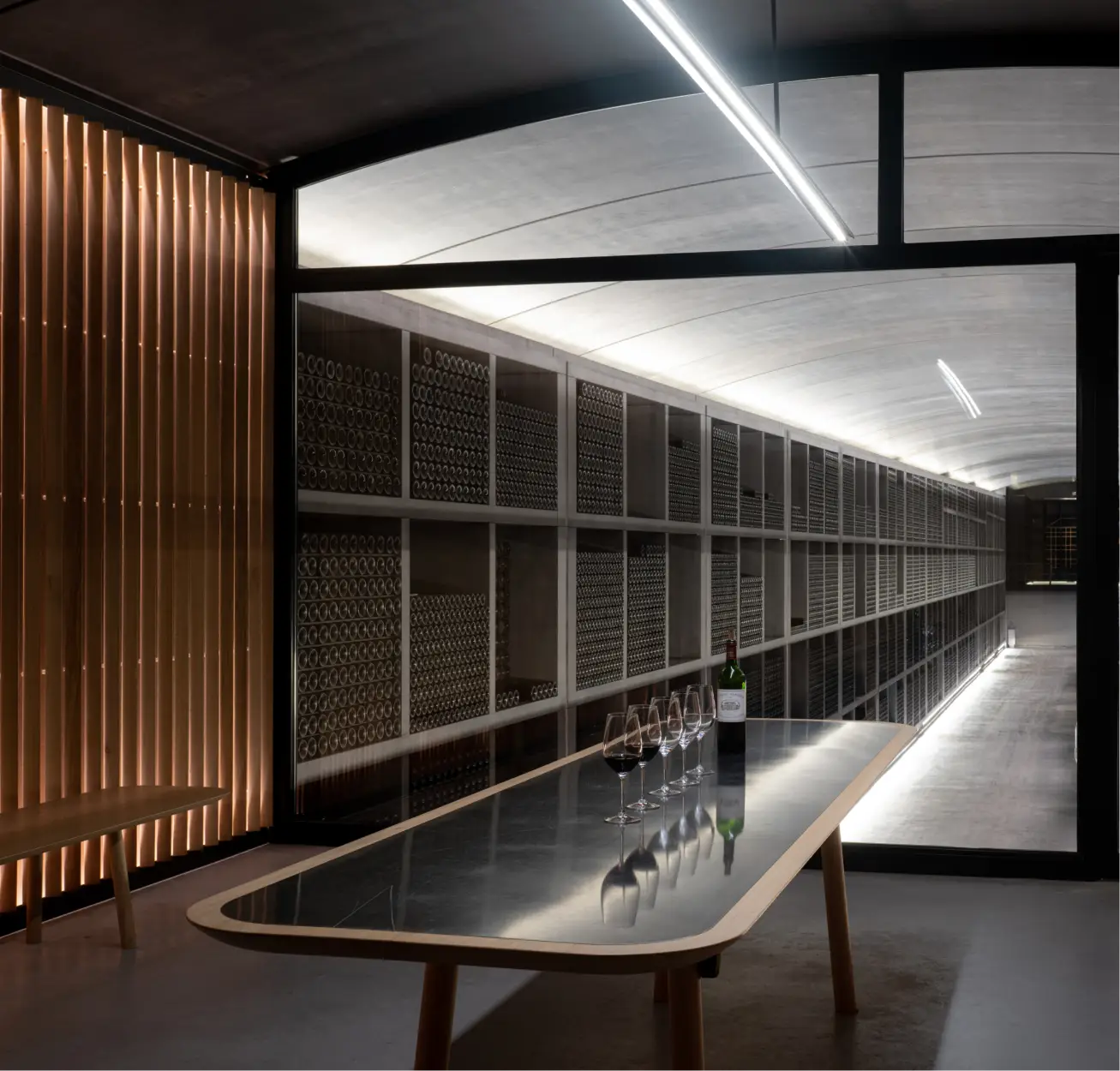
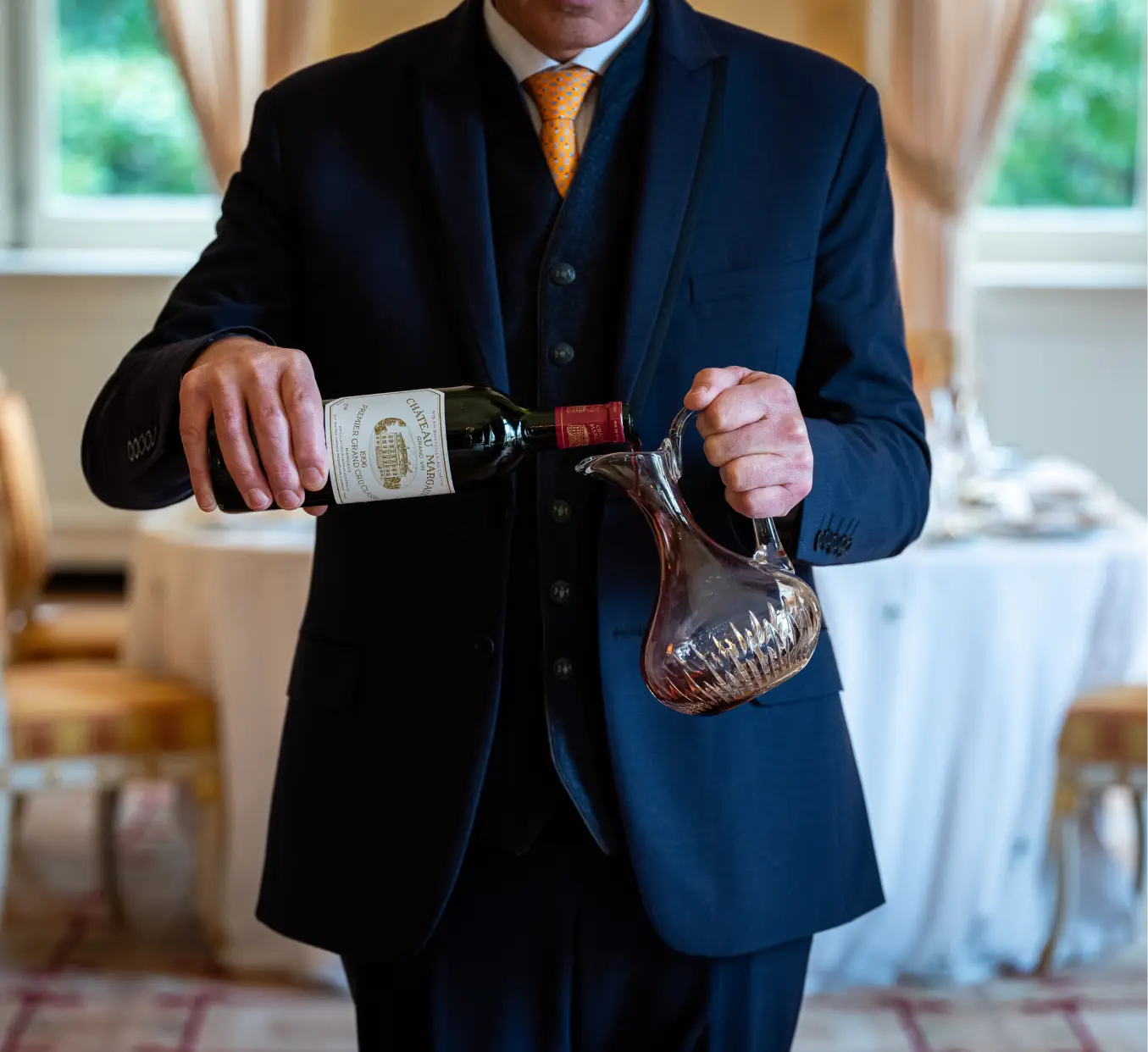
Service & tasting
Discover our tips for serving and tasting your wine in the best conditions.
Service & tasting
Discover our tips for serving and tasting your wine in the best conditions.